Winged sumac is a quiet workhorse for landowners managing property for wild turkey, bobwhite quail, ruffed grouse, white-tailed deer, and cottontail rabbits. It is not a primary food-plot forage. As a supporting habitat plant, however, providing late-winter food, brood cover, and the kind of woody edge that game animals use as travel and staging corridors, few native shrubs offer more value per planted acre.
This page lays out which game species actually use winged sumac, how to lay it out on a hunting property, and the honest caveats that habitat guides rarely mention. Every claim links to a primary source (USDA, USFS, NWTF, Quail Forever, state agencies, university extension).
5+
Game species supported
Wild turkey, bobwhite quail, ruffed grouse, white-tailed deer, and eastern cottontail all use winged sumac for food, browse, or cover.
4 ft
Habitat spacing
For working thickets, plant on roughly a 4-foot grid (2-3x denser than ornamental). About 100 seedlings on a 30 by 50 ft block forms a covey-headquarters thicket.
Winter
When sumac matters most
Berry cones persist on the plant through fall and into late winter, feeding game when soft mast and acorns are long gone.
Why Hunters and Landowners Plant Winged Sumac
Most habitat plantings on hunting properties focus on the heavy hitters: oaks for hard mast, clover and chufa for protein, native warm-season grasses for nesting cover. Winged sumac fills a different and complementary niche. It feeds wildlife in late winter when most other natural food has been stripped from the landscape. It provides loafing and brood-rearing structure at ground level. And it forms the woody-edge habitat that game animals use as the transition between open food plots and surrounding woods.
You plant it where your food plot meets the woods, along an old fence line, on the disturbed shoulder of a pasture, or in any sunny old-field corner where you want a wildlife-friendly thicket to develop on its own. Once established, it spreads via root suckers and densifies the cover without further input.[1]
Honest framing: Winged sumac is a supporting habitat plant, not a substitute for primary forage or hard-mast trees. It complements clover, chufa, oaks, and native grasses. Think of it as the late-winter pantry and the edge-cover layer, not the main dish.[1]
Game Species That Use Winged Sumac
The list below is restricted to species with documented use of winged sumac in primary wildlife literature. We have intentionally excluded species sometimes attributed to sumac generally (mourning dove, squirrels, black bear) where the evidence is weak, genus-level, or undocumented for Rhus copallinum specifically.
Wild Turkey
Meleagris gallopavo
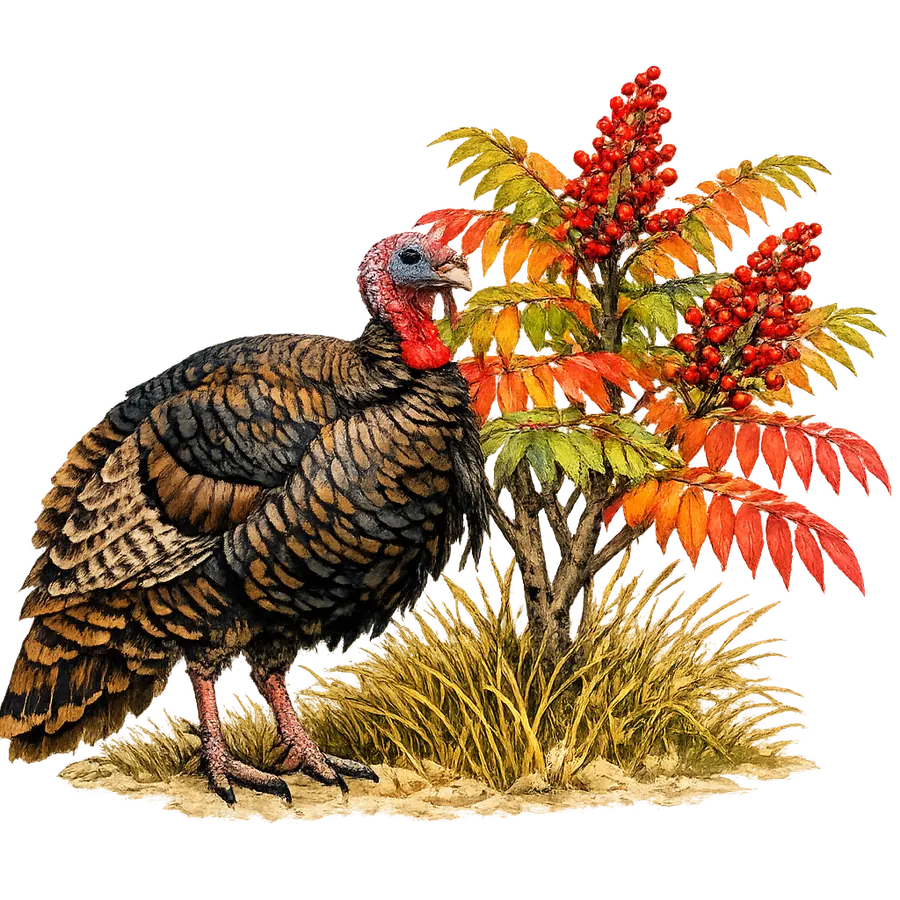
Berries persist on the plant from late summer through late winter, making winged sumac one of the carry-through foods turkeys rely on after acorns and softer fruits are gone.[1] The dense, suckering thicket structure also supports turkey brood habitat at ground level.[2]
Northern Bobwhite Quail
Colinus virginianus
Quail feed on the berry coating from late summer through early spring.[3] State wildlife agencies across the Southeast and South-Central U.S. specifically recommend winged sumac for building covey-headquarters thickets alongside American plum, sand plum, and smooth sumac.[3][4]
Ruffed Grouse
Bonasa umbellus
In the Appalachian portion of winged sumac's range, ruffed grouse feed on the berries as part of their fall and winter diet.[5] The Ruffed Grouse Society recommends sumacs as soft-edge plantings around forest clearings.[5] Most relevant to hunting properties in the northern and Appalachian extent of the species range.
White-Tailed Deer
Odocoileus virginianus
The honest answer: winged sumac is a useful supplement, not a top-tier deer forage. The USFS Fire Effects Information System classifies it as "poor to moderately important browse for white-tailed deer," with fruit chemistry that is "low in crude protein, crude fat, and calcium but high in tannin."[1] Deer browse the twigs and eat the fruit, especially in late winter when preferred forage is scarce.
Eastern Cottontail Rabbit
Sylvilagus floridanus
Cottontails browse the bark and twigs of winged sumac, particularly in winter when softer forage is unavailable.[1] The thicket structure also functions as escape and nesting cover for adults and young.
Plus 20+ Songbird Species
Indirect game-habitat value
Cedar waxwings, robins, bluebirds, brown thrashers, hermit thrushes, eastern towhees, and others feed on the berry cones.[6] The full songbird and insect community winged sumac supports, including larval host duty for Luna moth and Red-Banded Hairstreak butterfly, feeds the invertebrate base that turkey poults and quail chicks depend on during their first six weeks of life.[2]
Cover and Habitat Structure
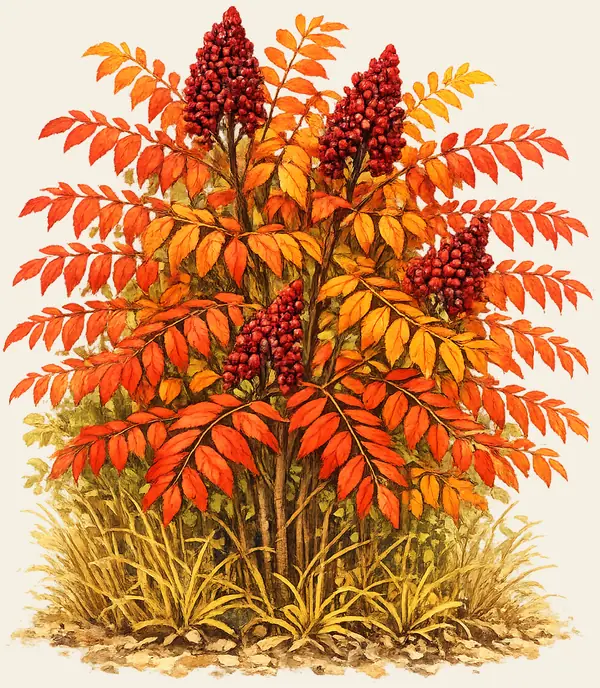
Beyond the food value, winged sumac's contribution to a hunting property is structural. A mature colony has an upper canopy of compound leaves at four to ten feet, with relatively open ground beneath the stems. This is exactly the architecture that turkey hens and quail hens select for brood-rearing.[2][7]
Brood cover for turkey poults and quail chicks
Young birds need overhead concealment from aerial predators combined with open ground at chick height so they can chase insects. State wildlife agencies list winged sumac among the plant communities that produce this structure when grown in colonies, alongside ragweed, partridge pea, and native warm-season grasses.[7]
Summer loafing and thermal cover
Quail use sumac thickets as midday shade and resting cover through the hotter months.[3]
Edge habitat
The most important structural role on most properties: winged sumac creates a soft transition between food plots, fields, and woods. Game uses this edge constantly. A sumac hedgerow along the wood-side of a food plot gives birds a staging area to approach the plot and an escape route into cover.
One caveat on winter cover: Winged sumac branches do not interlace as tightly as plums or chokecherry. For dense winter cover that blocks wind and conceals quail and small game in cold weather, plant winged sumac alongside dedicated winter-cover species, not in place of them.
How to Lay It Out on Your Property
The biggest difference between planting winged sumac for ornamental use and planting it for game habitat is density. Ornamental and erosion-control plantings space the plants 6 to 10 feet apart so each individual has room. Habitat plantings go much denser so the thicket fills in quickly and forms usable cover.
Recommended spacing for game habitat
Quail Forever and similar habitat guides recommend planting shrub thickets at roughly four feet apart. Approximately 100 seedlings on a 30-by-50-foot block forms a covey-headquarters-sized thicket that is usable within a few growing seasons.[4]
Layout patterns that work well
Hedgerows along food-plot edges and fencelines, creating soft transition zones between plots and surrounding cover.
Linear screens between food plots and travel lanes so game can approach the plot without exposure to the road.
Block thickets in old-field corners where you want a permanent covey-headquarters or turkey brood area to develop.
Soft buffers between row-cropped fields and adjacent woods for edge habitat and erosion control on field margins.
Companion Plants for a Working Habitat Planting
Winged sumac is most effective as part of a plant community rather than a monoculture. The species below come from quail-habitat and turkey-habitat guides published by state wildlife agencies and university extension services across the Southeast and South-Central U.S.[3][7]
American plum and sand plum, dense winter cover where winged sumac is thin.
Smooth sumac and fragrant sumac, extend the sumac food window and add structural variety.
Roughleaf dogwood, soft mast and dense cover combined.
Elderberry, chokecherry, blackberry, additional soft-mast layers with overlapping ripening windows.
False indigo bush, legume that fixes nitrogen and supports insects.
Partridge pea and ragweed, ground-level seed and brood-structure plants.
Native warm-season grasses underneath the woody layer: little bluestem, broomsedge bluestem, indiangrass.
Adjacent oaks and other hard-mast trees, the primary forage layer your sumac is complementing.
Management Considerations
The plant will spread
Winged sumac sends root suckers outward and forms clonal colonies over time. For a game-habitat planting, this is a feature: the thicket densifies on its own without additional cost. For a landowner who wants a clean edge, it is a maintenance commitment. Plant it where you want it to spread, or plant it where you can mow or disc the margins on a yearly rotation to keep the footprint in check.[1]
Fire is the preferred management tool
Winged sumac is fire-adapted. It resprouts vigorously from its roots after a burn. The USFS Fire Effects Information System notes that without periodic fire, "density and cover" decline, and a stand "rapidly declines 3 to 4 years following fire" if no rotation is maintained.[1] On a property with a regular prescribed-burn rotation, which is common for native warm-season grass and quail-habitat work, a 2-to-4-year burn return interval keeps winged sumac thickets vigorous.
Mowing has the opposite of its intended effect
Top-killing winged sumac by mowing or brush-hogging typically stimulates more suckering from the root system, not less. If you want fewer stems in a given footprint, prescribed fire works better than steel.[1]
Where winged sumac is not a fit
Wet, poorly drained soils. It will not establish in heavy clay or persistent moisture.
Heavy shade. Sparse, leggy growth, almost no berry production.
Pasture you intend to keep cleanly grazed by livestock. It will form unwanted thickets and crowd out forage.
Where Winged Sumac Shines as Game Habitat
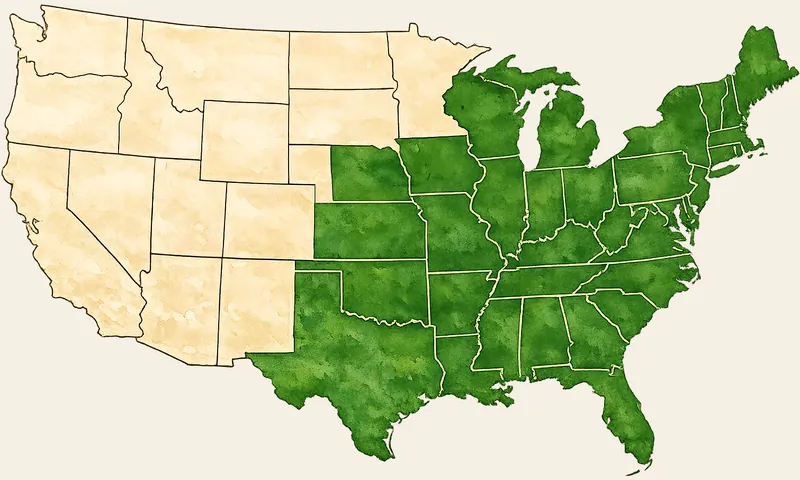
The species' strongest agency recommendations come from the Southeast and South-Central United States, where it is native and where its habitat value is best documented. State wildlife agencies and university extension services in Oklahoma, Texas, Missouri, Georgia, Tennessee, the Carolinas, and the Gulf Coast all actively recommend it for quail and turkey habitat work.[3][8][9]
In the northern reaches of the species range, northern Appalachia, the Great Lakes states, southern New England, winged sumac is still useful as supplemental food and edge structure. In those regions, ruffed grouse join the species list and the plant's value as a winter food source for songbirds and wildlife remains.[5]
Outside of the native range, winged sumac is hardy in USDA zones 4 through 9. It can be planted as a habitat shrub well beyond its natural footprint, though regional wildlife use will vary.
Related Guides
Winged sumac is a versatile plant. Beyond game habitat, it earns its place on the landscape in several other ways:
About the Plant, identification, native range, growing habits, and how it compares with other sumacs.
Planting Guide, how to grow winged sumac from seed, with refrigerator and outdoor sowing methods.
Wildlife Benefits, 20+ bird species fed, pollinator value, and host-plant role for Luna moth and Red-Banded Hairstreak.
Edible & Culinary Uses, the same berries that feed wildlife also make sumac lemonade, sumac tea, and sumac spice for your kitchen.
Plant Winged Sumac on Your Land
Hand-harvested seeds from native stands. Pack sizes from 200 seeds for a small starter planting to 3,000 seeds for habitat restoration and food-plot edges.