How to Plant Winged Sumac from Seed
Winged sumac seeds have a hard, protective seed coat that must be softened before they will germinate. With a brief hot-water treatment and a cold refrigerator rest, your seeds will be ready to sprout into a hardy native shrub valued for its brilliant fall color and outstanding wildlife support.
This guide walks through both methods so you can choose the one that fits your space and timing. If you're planting for wildlife or hunting habitat, see our wildlife benefits and game habitat and food plots guides for spacing and use. For uses of the harvested berries, see edible sumac and its culinary uses.
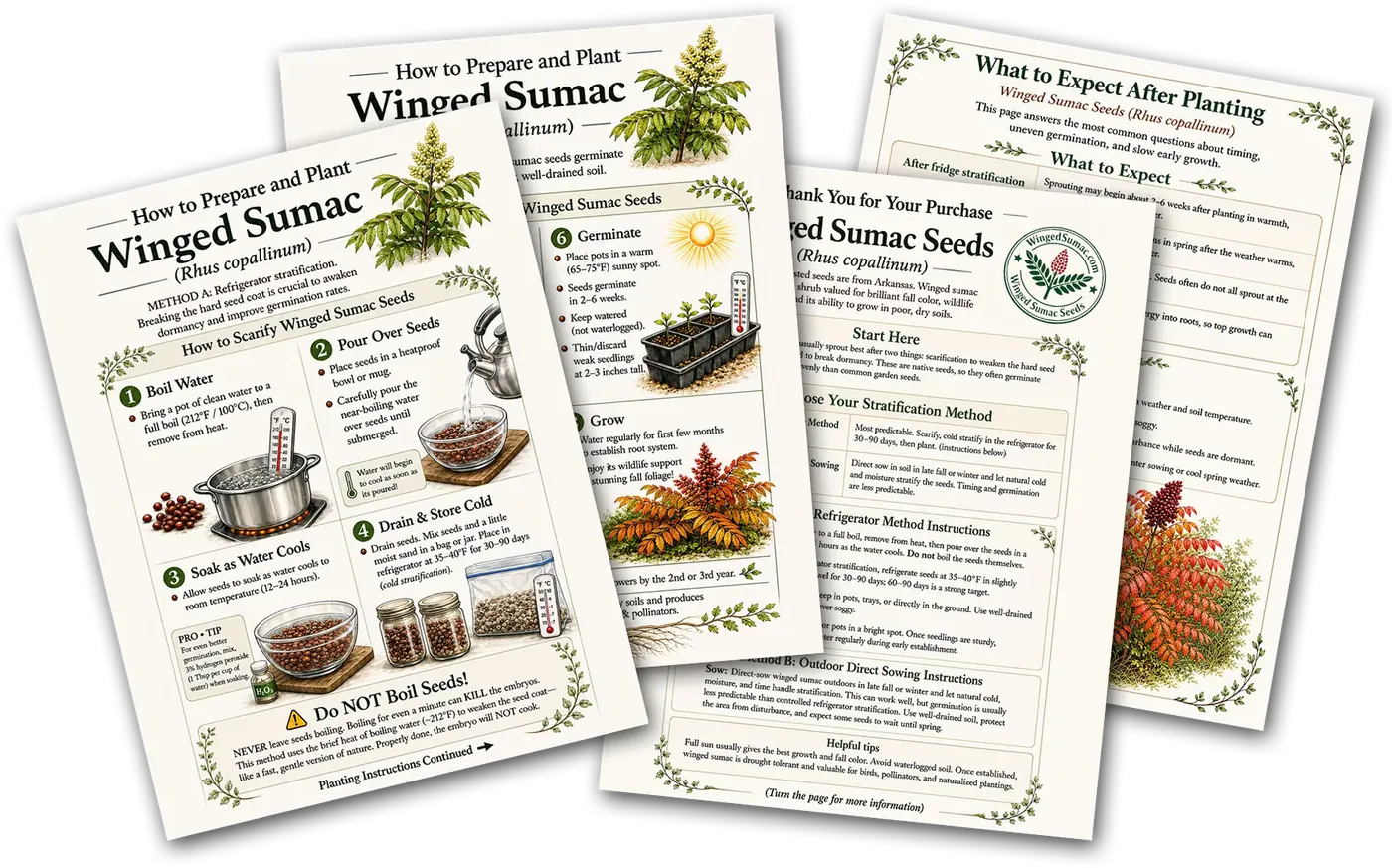
Every order includes a FREE 4-page Winged Sumac Planting Guide
that is printed and shipped with your seeds.
Why Winged Sumac Seeds Need Special Treatment
Winged sumac is a wild plant, not a hybrid garden crop. Its seeds evolved to wait for two natural signals before sprouting: a brief burst of warmth (mimicked by passing through a bird, animal digestion, or a small fire), and a period of cold winter weather. Without those signals, the hard seed coat stays sealed and the embryo inside stays dormant, sometimes for years.[1]
You can recreate those signals in just a few minutes of kitchen work plus 30–90 days in the refrigerator.[2] The result is far more even germination than tossing seeds into the ground and hoping for the best.
When Should I Plant?
Early spring is the most reliable planting window in cooler regions (USDA zones 4–7), once daytime temperatures climb above 50°F but while the plant is still leafless and dormant. In warmer zones (8–9), fall planting is preferred so roots establish during the cooler, wetter season before summer heat.
If you're using Method A (refrigerator), work backward from your target planting date: stratification needs 8–12 weeks, so start the process in late January or early February for an April–May plant-out.[2]
If you're using Method B (outdoor), sow in late fall or early winter so the seeds get the natural cold cycle they need to break dormancy.[1]
Storing seeds for later? Winged sumac seeds have a famously hard seed coat and remain viable for at least 10 years when kept cool and dry.[3] You can buy a pack this year and plant some or all of it next year, the year after, or several years later, with no loss of germination as long as the seeds stay in a sealed envelope in a cool, dry place.
| Method A: Refrigerator Recommended |
Start 8–12 weeks before your target planting date. Most predictable and fastest. Scarify the seeds with hot water, then cold-stratify in the refrigerator for 30–90 days.[2] After stratification, sow within 1–2 weeks so the seeds don't dry back.[4] Best for indoor growers and gardeners who want strong, even germination on a controlled timeline. |
| Method B: Outdoor Direct Sowing |
Sow in late fall or winter and let natural cold, moisture, and time do the work. Germination is less predictable and tends to be more uneven, but it requires no fridge space or active prep. |
1Boil Water
- Bring a pot of clean water to a full rolling boil (212°F / 100°C).
- Remove the pot from the heat immediately.
Do NOT boil the seeds
Even one minute of active boiling can kill the embryo. The hot-water method works because the brief heat of just-poured water weakens the seed coat without cooking what's inside.
2Pour Over Seeds
- Place seeds in a heatproof bowl or mug.
- Carefully pour the near-boiling water over the seeds until they are fully submerged.
- The water will begin to cool the moment it touches the seeds, which is exactly what you want.
3Soak as Water Cools
- Let the seeds soak as the water gradually returns to room temperature.
- Plan on 12–24 hours total soak time.
Pro tip
For even better germination, add 1 Tbsp of 3% hydrogen peroxide per cup of water when soaking. It helps soften the seed coat further and reduces fungal issues.
4Drain & Store Cold
- Drain the seeds. Mix with a little slightly moist sand, peat, or sphagnum moss.
- Place the mixture in a sealed bag or jar.
- Refrigerate at 35–40°F for 30–90 days (60–90 days is a strong target).
5Sow
- Sow seeds 1/8 to 1/4 inch deep in pots, trays, or directly in a sunny, well-drained spot.
- Cover lightly with soil and water gently.
- Best sown in spring or fall.
6Germinate
- Place pots in a warm (65–75°F), sunny spot.
- Seeds germinate in 2–6 weeks. Keep soil lightly moist, never soggy.
- Thin or discard weak seedlings once they reach 2–3 inches tall.
7Transplant
- Move sturdy seedlings outdoors in spring or fall.
- Choose a full-sun site with well-drained soil. Rocky or poor soil is fine.
8Grow
- Water regularly for the first few months to help the root system establish.
- Expect modest above-ground growth in year one. Flowers typically arrive in year two or three.
- After that, enjoy decades of brilliant fall color and a steady draw of birds and pollinators.
METHOD B · OUTDOOR DIRECT SOWING
Let the Weather Stratify the Seeds for You
If you'd rather skip the refrigerator step, you can sow winged sumac seeds directly outdoors in late fall or early winter and let natural cold, moisture, and time handle stratification. This works well in cool-winter regions, though germination is usually slower and less even than the refrigerator method.
- Choose a well-drained spot with full sun for at least half the day.
- Sow 1/8 to 1/4 inch deep and lightly cover with soil.
- Mark the planting spot clearly so it isn't disturbed over winter.
- Be patient. Some seeds will sprout in spring; others may wait until the following year.
What to Expect After Planting
| After refrigerator stratification |
Germination usually begins about 2–6 weeks after planting in a warm, bright spot, though some individual seeds may take longer. |
| After winter direct-sowing |
Most sprouting happens in spring after the weather warms. A portion of seeds may wait until the following year. |
| Germination pattern |
Uneven germination is completely normal for native seeds. Seeds rarely all sprout at the same time. This staggered emergence is a survival strategy. |
| First-year growth |
Young plants put early energy into root development, so above-ground growth can look modest the first season. Expect more visible growth in year two, with flowers by year three. |
Good to Know
- Not every seed will sprout. That is normal for native seeds. Order a few more than your target plant count.
- Cool soil slows germination. Outdoor timing depends heavily on weather and soil temperature, not the calendar.
- Overwatering can rot seeds. Keep soil lightly moist rather than soggy.
- Mark your outdoor planting spots. This helps prevent accidental disturbance while seeds are still dormant underground.
- Give them time. Don't assume failure too quickly, especially with winter sowing or unusually cool spring weather.
More germination and growing questions? See our FAQ or learn more about the plant.
A Note from the Grower
Winged sumac rewards patience. Slow and uneven sprouting is normal, and winter-sown seeds may not emerge until the following spring. With a little care up front, your plants will reward you with decades of brilliant fall color and a steady draw of birds, bees, and pollinators.
Shop Winged Sumac Seeds