Native Shrubs for Erosion Control on Slopes and Banks
A bare slope loses soil every time it rains. Grass helps, but on a steep yard, a road cut, the face of a pond dam, or a cleared hillside, a thicket of native shrubs with spreading roots is often what finally holds the ground for good.
This page is about choosing the right shrub for the right spot, and about how we would seed a dry slope with winged sumac, the plant we harvest from wild stands here in Arkansas. We will be honest about where it works and where it does not. For the plant itself, see about winged sumac.
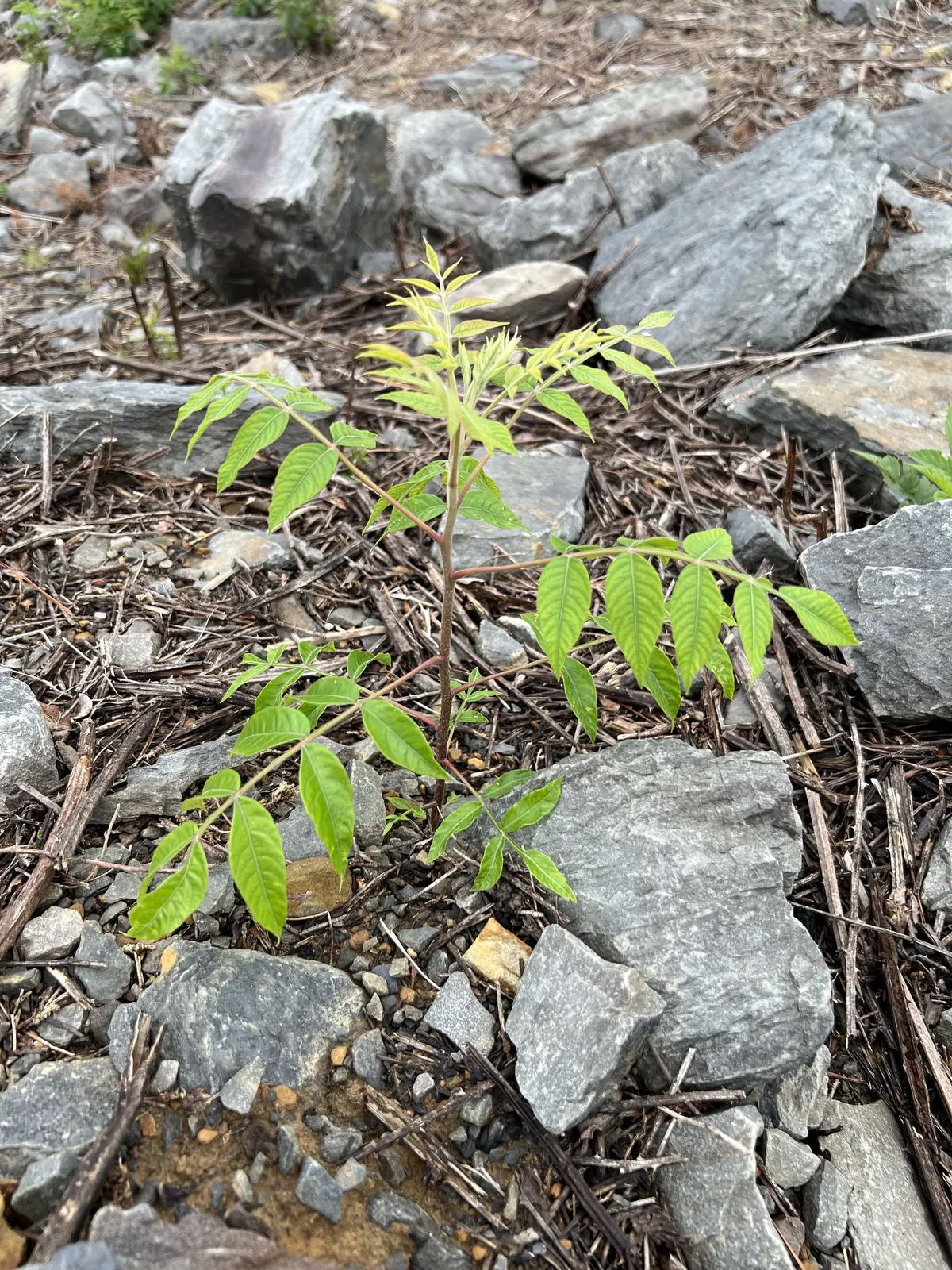
Why Thicket-Forming Shrubs Are Good at Holding Soil
Erosion starts at the surface: raindrops knock soil loose, and water running downhill carries it away. Anything that covers the ground, slows the water, and ties the soil together with roots will help. A shrub that spreads underground does all three, and it keeps doing them for years without being replanted.
Many native sumacs work this way. Instead of staying a single plant, they send roots outward and push up new stems along them, so one seedling slowly becomes a patch and a patch becomes a thicket. The USDA NRCS fact sheet for winged sumac describes its lateral root system as extensive, spreading outward three or more feet a year once a stand is established.[1] NC State Extension recommends it for use "on slopes for erosion control where it will spread by suckers."[2]
That spreading habit is the whole point on a slope. Every new stem is another anchor, the leaf litter under the thicket covers bare soil, and cutting or fire tends to make the colony sprout more from its roots rather than less.[1]
Winged Sumac for Dry Slopes, Road Cuts, and Rocky Ground
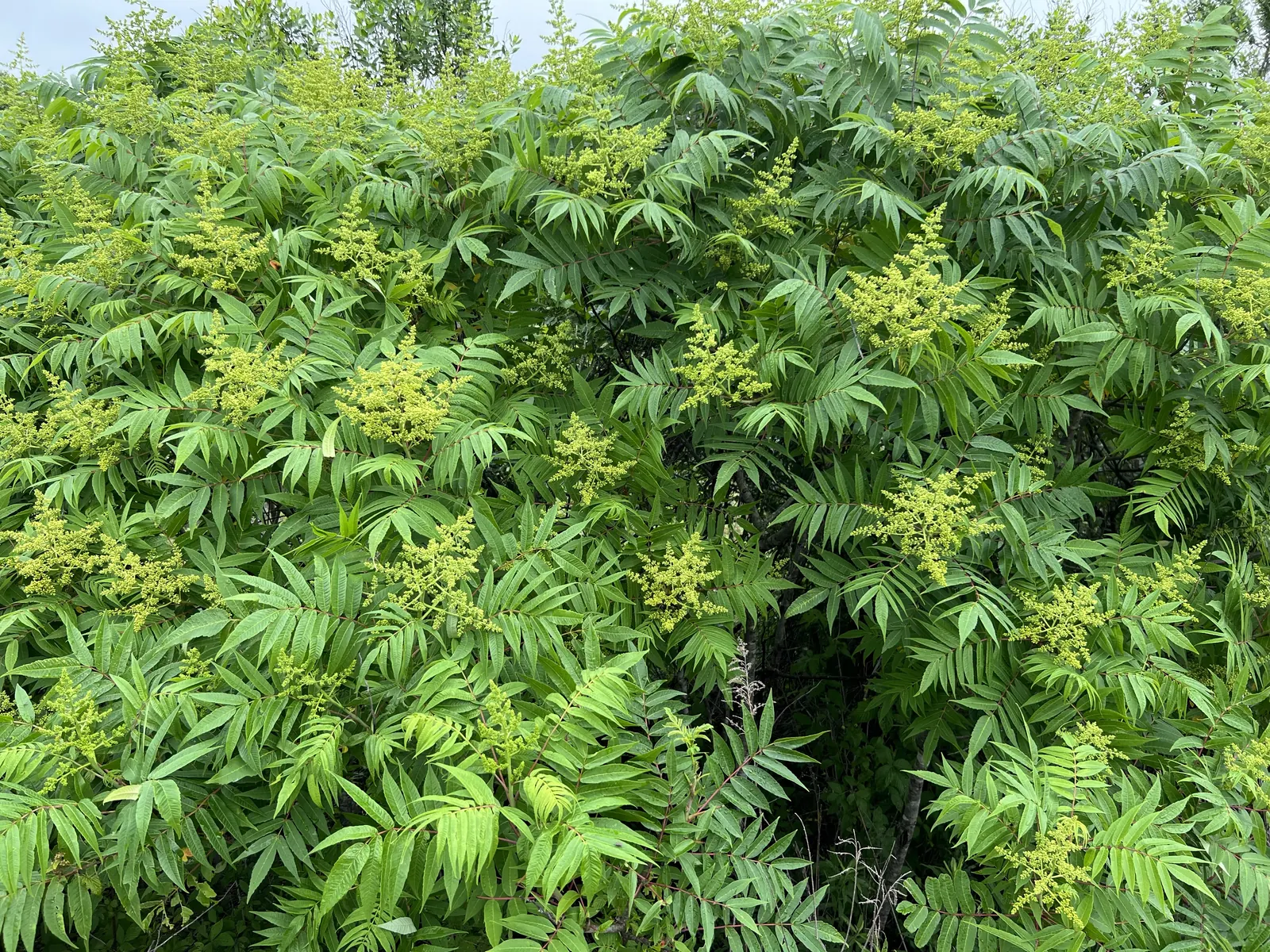
Winged sumac (Rhus copallinum) is a pioneer shrub. It is one of the first natives to move into old fields, roadsides, fence rows, burned ground, and other disturbed sites, and the NRCS says it is best used "on drastically disturbed sites where pioneer species are desirable."[1] That is a fair description of most eroding slopes.
- Poor, dry, rocky soil. The Lady Bird Johnson Wildflower Center lists it for dry, rocky, poor soils with low water use, and the Forest Service notes it tolerates drought.[4][3]
- It forms colonies. Root suckers fill in the gaps between plants on their own over the years.[2]
- Quick cover once it is going. The Forest Service describes it as a fast-growing pioneer that does best in full sun.[3]
- Fall color and wildlife. The same thicket that holds your bank turns scarlet in autumn and feeds birds through winter. See our wildlife benefits and game habitat pages.
Where Winged Sumac Is the Wrong Choice
We would rather you plant the right thing than buy our seed for the wrong job. Winged sumac has real limits for erosion work:
- It needs well-drained ground. NC State Extension says it tolerates a wide range of soils "except for wet sites,"[2] and the Forest Service notes that on poorly drained soil its growth is very slow.[3] It is not a plant for a creek edge that stays wet, the waterline of a pond, a ditch bottom that holds water, or anywhere with standing water. Use the wet-bank plants below for those spots.
- The colony will spread. On a slope that is what you want, but plan for it. Keep it away from lawn edges, septic fields, and garden beds, and leave yourself a strip you can mow at the margins. Our game habitat guide covers managing the spread.
- Seedlings are not an instant fix. Seedlings stay small in their first season. A newly seeded slope needs other protection, mulch or an erosion blanket plus a quick nurse crop, for the first season or two while the shrubs catch up.
- It needs sun. Sumacs are early-successional plants and are seldom found growing under a closed canopy.[1] A shaded bank under big trees is not a good fit.
- Very steep or very long slopes need more than plants. Kentucky's state erosion guide calls for erosion blankets or mats on most slopes steeper than 3 to 1 (one foot of rise for every three feet across), and some slopes also need runoff diverted away from the top.[10] If water is pouring over the slope from above, fix that first.
Other Native Shrubs and Grasses for Erosion Control
A mix of plants holds a slope better than any single species. Here are well-documented natives of the eastern and central United States, split by the kind of site you have. Check that each one is native and available in your area before you buy.
| Plant | Type | Why it works |
|---|---|---|
| Dry slopes, road cuts, and banks above the waterline | ||
| Winged sumac (Rhus copallinum) | Shrub, 7 to 15 ft | Suckers into colonies on poor, dry, rocky ground.[2] |
| Fragrant sumac (Rhus aromatica) | Low shrub, 2 to 6 ft | NC State calls mass plantings "excellent for stabilizing banks and slopes." Needs good drainage.[5] |
| Coralberry (Symphoricarpos orbiculatus) | Low shrub, 2 to 4 ft | Dense, suckering groundcover recommended for slopes; moist to dry, loamy or rocky soil.[6] |
| Little bluestem (Schizachyrium scoparium) | Bunch grass | Penn State lists it for a sunny slope; reseeds readily.[7] |
| River oats (Chasmanthium latifolium) | Grass | Good for slopes because it forms a firm root mass.[7] |
| Wet stream banks and pond edges | ||
| Silky dogwood (Cornus amomum) | Shrub | Medium to wet soils, fibrous roots; planted as live stakes.[8][9] |
| Buttonbush (Cephalanthus occidentalis) | Shrub | A standard stream-repair shrub for wet ground; live stakes.[8][9] |
| Elderberry (Sambucus) | Shrub | Medium to wet soils, fibrous roots; live stakes.[8][9] |
| Silky willow (Salix sericea) | Shrub | Listed by NC State for streambank live staking.[9] |
On a bank that runs from a dry top down to a wet bottom, use both lists: winged sumac and the dry-site plants up high, dogwood, buttonbush, and willow down at the water. Wet-bank shrubs are usually planted as live stakes, which are dormant cuttings pushed into the bank, and NC State recommends cutting and planting them from November to February.[9] For the bigger picture of planting for wildlife, see native plants for birds and pollinators.
How to Seed a Slope with Winged Sumac, Step by Step
This is the plan we would follow on a dry, sunny slope. Adjust it for your ground, and if the site is large or seriously eroding, talk to your local conservation office first (more on that below).
-
Stop the water from above
If runoff from a driveway, roof, or field is pouring over the top of the slope, no planting will keep up with it. Kentucky's erosion guide lists diverting upland runoff around the bare area as one of its main slope fixes.[10] A low berm or swale at the top can make the difference.
-
Prepare the seed
Winged sumac seed has a hard coat. For a spring sowing, give it the hot-water soak and 30 to 90 days of cold, moist storage in the refrigerator described in our planting guide and our guide to scarifying and cold stratifying seeds. If you sow in late fall or early winter instead, winter does the cold part for you, though sprouting is slower and less even.
-
Pick your sowing time
Follow the timing in the planting guide: early spring in cooler regions (zones 4 to 7) with stratified seed, or a late fall or winter sowing so the weather stratifies it. In warmer zones (8 to 9), fall planting lets roots get going in the cooler, wetter season.
-
Rough up the soil, do not smooth it
A rough, loose surface holds water and seed better than a smooth, packed one. Kentucky's guide estimates a compacted, smooth slope erodes about 30 percent more, while a rough, irregular surface erodes about 10 percent less.[10] Rake or scuff the ground and pull out weeds that would shade young seedlings.
-
Sow in spots across the slope
Rather than scattering seed loosely where rain can wash it downhill, sow in small pockets. Scrape out a small pocket, drop in about six seeds, cover them about 1/2 inch deep, and press the soil down with your boot. Lay the pockets out in rows that run across the slope, staggering each row so the spots are not lined up straight downhill. Spacing is covered in the seed quantity section below.
-
Add a light nurse crop for year one
Sumac seedlings will not cover the ground in their first season, so give the soil something quick. Georgia NRCS guidance for native seedings allows light rates of oats or buckwheat as a nurse crop, and advises against winter wheat, winter rye, perennial rye, or introduced clovers because some can suppress germination or out-compete young plants.[11] Keep it light so the sumac gets the sun.
-
Cover it with mulch or an erosion blanket
On gentle slopes, a thin layer of weed-free straw helps hold seed and soil. On slopes steeper than about 3 to 1, or long slopes, use an erosion control blanket, and put the seed down before the blanket goes on.[10] Run blankets up and down the slope, anchor the top edge well, and staple as the maker directs. Penn State Extension suggests natural-fiber netting on steep slopes.[7]
-
Follow up for two seasons
Mark the spots so you can find them. Expect uneven sprouting: some seed comes up in spring, some waits a year. Water young seedlings in dry spells during their first months, pull weeds that tower over them, and patch any rills after big storms. In spots that stay empty, resow or move a spare seedling over from a crowded spot. By the second or third season the colony starts to knit together.
How Many Seeds Do You Need to Cover a Slope?
Plan on about 30 to 40% of our seed sprouting under good conditions. Outdoors on a hot, dry slope, expect fewer, and not every seedling survives its first summer. That is why we suggest about six seeds per spot: on average it gives one or two seedlings, and some spots will still come up empty.
For a dry slope where you are happy to let the colony fill in, spots about 6 feet apart work well, in line with the 6 to 10 foot spacing we suggest for slopes and hedgerows on our plant page. Here is roughly what each pack covers at six seeds per spot:
| Pack | Spots (6 seeds each) | Area at 6 ft spacing |
|---|---|---|
| 500 seeds | About 80 | About 3,000 sq ft |
| 1,500 seeds | About 250 | About 9,000 sq ft (a fifth of an acre) |
| 3,000 seeds | About 500 | About 18,000 sq ft (roughly 0.4 acre) |
For a gully, a steep spot, or anywhere you want the thicket to close faster, tighten the spacing to about 4 feet. That cuts the area each pack covers by more than half, so a 3,000-seed pack would plant about 8,000 square feet. These are planning numbers, not promises: weather, soil, and timing matter more than the arithmetic.
The 1,500 and 3,000 seed packs are sized for this kind of work: a road cut, a pond dam face, or a cleared hillside. For bigger acreage, ask us about wholesale quantities. You can compare all pack sizes in the shop or read more about sumac seeds.
Getting Help from NRCS and Your Conservation District
If you farm or own forest land with a serious erosion problem, it is worth a call to your local USDA NRCS office or soil and water conservation district before you buy anything. The NRCS Environmental Quality Incentives Program (EQIP) offers technical and financial assistance to agricultural producers and forest landowners for resource concerns that include erosion.[12] Whether money is available depends on your state, your eligibility, and funding that year. Even if you do not qualify, the local office can tell you which plants and practices work in your county. The NRCS winged sumac fact sheet itself points readers to their local NRCS field office or conservation district.[1]
Erosion Control Questions
What is the best plant for erosion control on a slope?
There is no single best plant. On a dry, sunny slope, a mix of thicket-forming native shrubs like winged sumac or fragrant sumac with native grasses such as little bluestem works well. On a wet stream bank, use water-loving shrubs like silky dogwood, buttonbush, elderberry, and willow.
Can I plant winged sumac on a stream bank?
Only on the dry upper part of the bank. Winged sumac does poorly on wet sites, so it is not suited to the water's edge or ground that stays soggy. Use wet-tolerant shrubs at the waterline.
How fast will winged sumac hold a slope?
Not in the first season. Seedlings stay small in year one, so protect the slope with mulch or an erosion blanket and a light nurse crop. Once a stand is established, its roots spread outward and new stems fill in over the following seasons.
Will winged sumac take over my yard?
It spreads by root suckers and forms colonies, so plant it where spreading is welcome and keep a mowable strip at the edges. Cutting a stand back tends to make it resprout from the roots, so plan the footprint before you plant.
Seed for Your Slope
Hand-harvested winged sumac seed from native stands, with free shipping. The 1,500 and 3,000 seed packs are sized for slopes, road cuts, and banks. For larger projects, ask about wholesale.
Shop Seed PacksSources
12 references- USDA NRCS Plant Fact Sheet. Winged sumac, Rhus copallinum (extensive lateral roots spreading three or more feet a year; best on drastically disturbed sites; sprouting encouraged by cutting or fire; not shade tolerant). plants.usda.gov/DocumentLibrary/factsheet/pdf/fs_rhco.pdf
- NC State Extension Gardener Plant Toolbox. Rhus copallinum (use on slopes for erosion control; spreads by root suckers into large colonies; tolerates poor soils except wet sites). plants.ces.ncsu.edu/plants/rhus-copallinum
- USDA Forest Service, Fire Effects Information System (FEIS). Rhus copallinum species review (fast-growing pioneer, full sun, drought tolerant, very slow growth on poorly drained soils, sprouts from roots and root crown). research.fs.usda.gov/feis/species-reviews/rhucop
- Lady Bird Johnson Wildflower Center. Rhus copallinum (low water use, dry rocky poor soils, often forms thickets). wildflower.org/plants/result.php?id_plant=RHCO
- NC State Extension Gardener Plant Toolbox. Rhus aromatica, fragrant sumac (stabilizing banks and slopes in mass plantings). plants.ces.ncsu.edu/plants/rhus-aromatica
- NC State Extension Gardener Plant Toolbox. Symphoricarpos orbiculatus, coralberry (groundcover for slopes and erosion control). plants.ces.ncsu.edu/plants/symphoricarpos-orbiculatus
- Penn State Extension. "Native Groundcovers Can Solve Tough Challenges in the Landscape" (little bluestem and river oats for slopes; natural-fiber netting on steep slopes). extension.psu.edu/native-groundcovers-can-solve-tough-challenges-in-the-landscape
- Penn State Extension. "Common Live Stake Species for Residential Stream Repair" (silky dogwood, buttonbush, elderberry; medium to wet soils; fibrous roots). extension.psu.edu/common-live-stake-species-for-residential-stream-repair
- NC State University, Biological and Agricultural Engineering. Live Stake Installation Guide (species list; cut and plant November to February). bae.ncsu.edu/workshops-conferences/live-stake-installation-guide
- Kentucky Energy and Environment Cabinet. Kentucky Erosion Prevention and Sediment Control Guide, "Protecting Slopes to Prevent Gullies" (blankets or mats on most slopes over 3:1; divert upland runoff; seed before blanketing; surface roughness). eec.ky.gov/Environmental-Protection/Water/Protection/DocsEPSC/EPSC-ProtectSlopes.pdf
- USDA NRCS Georgia. Native Grasses implementation requirements, practice 420 (light nurse crops of oats or buckwheat; avoid winter wheat, winter rye, perennial rye, introduced clovers). efotg.sc.egov.usda.gov/api/CPSFile/41430/420_GA_IR_Native_Grasses_2023_pdf
- USDA NRCS. Environmental Quality Incentives Program (EQIP) (technical and financial assistance to agricultural producers and forest landowners). nrcs.usda.gov/programs-initiatives/environmental-quality-incentives-program