Sumac Seeds: A Buyer's and Grower's Guide
Sumac is one of the easier native shrubs to grow from seed, once you know what you are holding. Every sumac seed sits inside a small, fuzzy red fruit, wears a coat hard enough to stay dormant for years, and needs a little help before it will sprout.
This guide covers what a sumac seed is, how staghorn, smooth, winged, and fragrant sumac seed compare, how long seed keeps, how many seeds to buy for the plants you want, and what to check before you buy. We are a small Arkansas grower and we sell one thing: wild-harvested winged sumac seed. Where another species suits your project better, we will say so.
What Is a Sumac Seed?
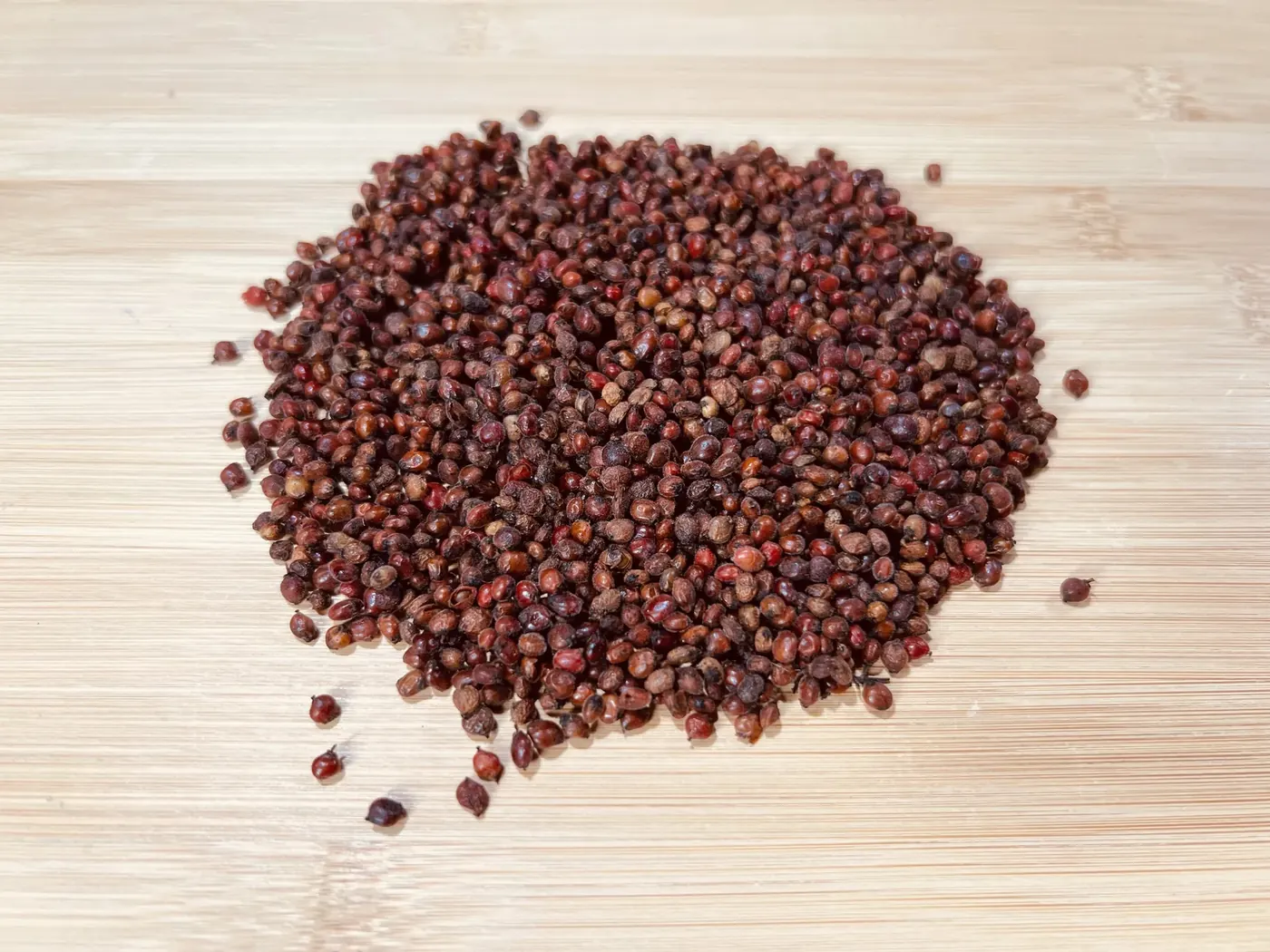
Sumac fruits are small, hairy, berry-like drupes. Each one holds a single hard seed, sometimes called a nutlet.[1] The fruits grow in dense clusters at the branch tips, ripen from late summer into fall, and often hang on through winter. The sour, fuzzy red outside is what birds and people are after. The seed in the middle is what grows the next plant.
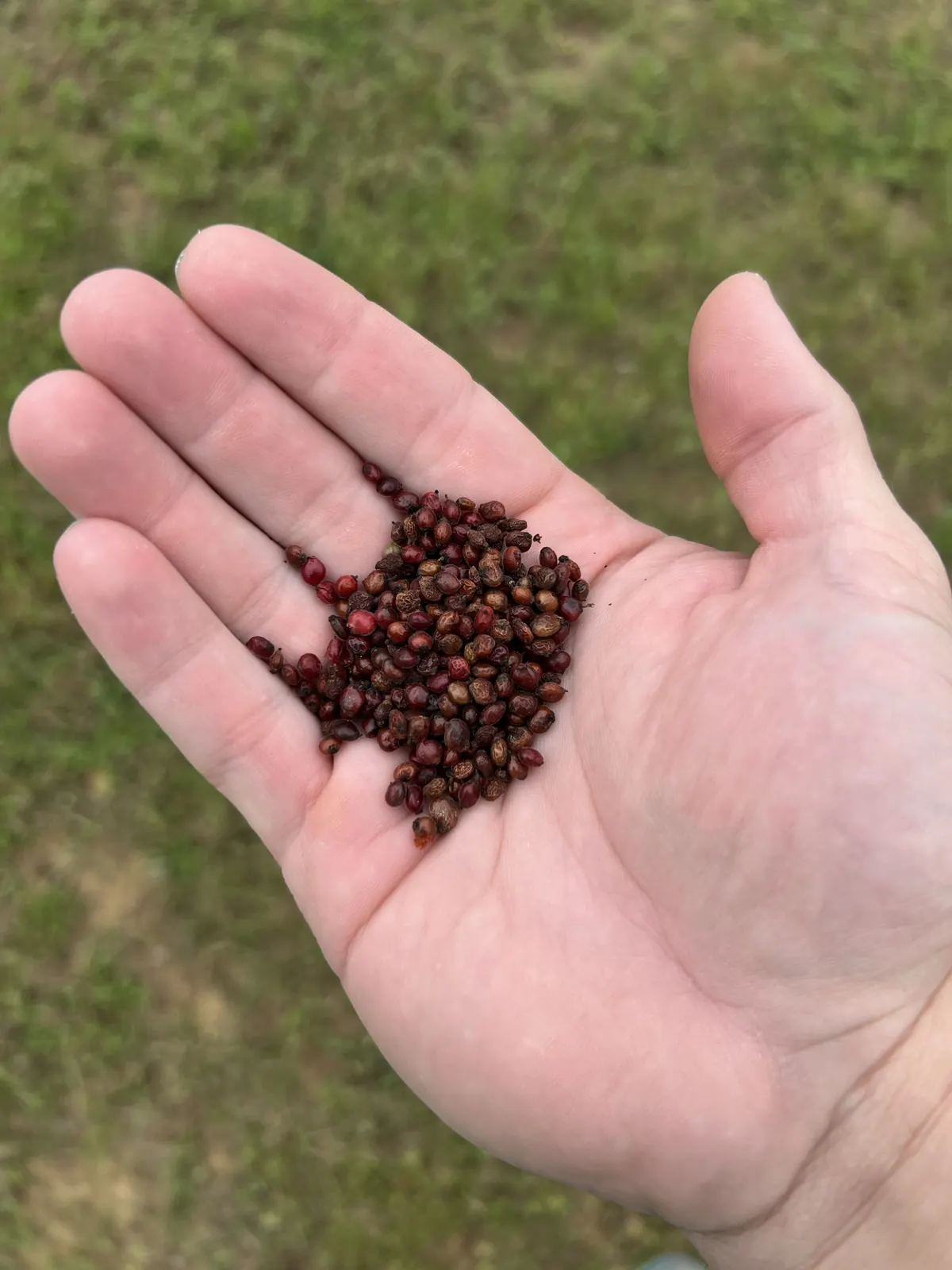
The seeds are small. The USDA Forest Service Woody Plant Seed Manual lists cleaned winged sumac seed at about 57,000 seeds per pound on average, with samples running from about 37,000 to 79,000. Smooth sumac averages about 49,000 per pound and staghorn about 53,000.[1] That is why sumac seed is usually sold by count rather than by weight.
Most sumac seed is planted with some of the dried fruit wall still on it. The same manual notes that cleaning all the way down to the bare seed is seldom done for most species.[1] Our packs are loose, individual seeds, not whole clusters, and you will see a little red skin on many of them. That is normal for sumac seed.
Staghorn, Smooth, Winged, and Fragrant Sumac Seed Compared
Four native sumacs make up most of the seed people shop for. Their seeds look much alike, but the plants are quite different, so pick the plant first and then buy its seed. For a fuller look at the plants themselves, see our guide to the types of sumac.
| Species | The plant | Seed notes | Before sowing |
|---|---|---|---|
| Winged sumac Rhus copallinumWhat we sell | Usually 7 to 15 ft as a shrub, up to 20 to 30 ft as a small tree. Winged leaf stems, brilliant red fall color, tolerates poor, dry, rocky soil.[6][7] | About 57,000 cleaned seeds per pound. Very hard seed coat. | Hot-water scarification. Cold chilling is not strictly required, but 30 to 90 days gives a more even start. |
| Staghorn sumac Rhus typhina | 15 to 25 ft. Velvety young twigs, large leaves, more northern range. | About 53,000 per pound. Where staghorn and smooth sumac grow together they can cross, and the hybrid clumps often carry mostly empty seed. | Scarify. In trials, longer cold chilling raised germination. |
| Smooth sumac Rhus glabra | 10 to 20 ft. Hairless twigs, otherwise much like staghorn. | About 49,000 per pound. Very long-lived seed. | Scarify, then about 2 months of cold chilling, or sow in fall. |
| Fragrant sumac Rhus aromatica | Low, spreading shrub, usually 2 to 6 ft. Three-part leaves, aromatic when crushed. | Hard coat plus a dormant embryo, so it needs both treatments. | Scarify, then 1 to 3 months of cold chilling, or scarify and sow in fall. |
The short version: every one of these sumacs has a seed coat that water cannot get through until something softens or cracks it. In the wild that job falls to fire and weather. In the kitchen it is a hot-water soak. Fragrant sumac also has an embryo that will not wake up without a cold spell, so it truly needs both steps. For winged, staghorn, and smooth sumac the hard coat is the main lock, and the Forest Service seed manual lists them among seeds that do not require a cold period. Even so, the standard advice is to follow scarification with about two months of cold, moist chilling, and that is what we recommend for our seed.[1][2]
We only sell winged sumac. If you need staghorn for a cold northern site, or fragrant sumac as a low shrub for a bank or foundation planting, buy seed of that species from a seller who names it in Latin and tells you where it was collected.
How Long Do Sumac Seeds Stay Viable?
A long time, though not forever. Sumac seed is the kind that stores well dry. The Woody Plant Seed Manual records smooth sumac seed that still germinated at over 60% after 10 years at room temperature, and winged sumac seed that survived five years buried in soil in Louisiana.[1] Some seeds lose their life over the years, so for the best results plant within a few years.
To store seed, keep it in a sealed envelope or jar in a cool, dark, dry place. A sealed jar in the refrigerator is ideal: the manual recommends sealed glass containers at about 37°F (3°C) for winged and smooth sumac seed.[1] The one thing to avoid is damp storage, because moisture is part of what tells a seed to start growing. This is also why a big pack is not a use-it-or-lose-it buy: plant part of it this year and save the rest for next season or the one after.
Sumac Seeds vs. Seedlings and Potted Plants
You can buy sumac three ways: as seed, as bare-root seedlings, or as a potted shrub from a nursery. Each has its place.
- Cost per plant. A pack of seed costs about the same as one or two potted nursery shrubs, and it can give you dozens to hundreds of seedlings. If you need more than a handful of plants, seed wins by a wide margin.
- Time. A potted plant gives you a head start of a year or more. From seed, plan on two to three months of preparation before sowing, and on winged sumac usually bearing its first fruit at 3 to 4 years old.[4]
- Both sexes. Winged sumac plants are either male or female, and only females bear berries. Many sumacs sold commercially are grown from root cuttings rather than seed.[1] Cuttings taken from one parent are copies of it, so they are all the same sex. A batch of seedlings is a natural mix of males and females, which is what a berry crop needs.
- Effort. A potted shrub goes straight in the ground. Seed asks for a hot-water soak, some refrigerator space, and a little patience.
Our honest take: for one specimen shrub by the patio, a potted plant is fine. For a hedge, a wildlife thicket, a slope, or a long field edge, seed is the practical choice.
How Many Sumac Seeds Should I Buy?
Plan on about 30 to 40% of our winged sumac seeds sprouting when they are scarified and cold-stratified as our planting guide describes. That range is normal for native woody seed. The Woody Plant Seed Manual reports germination of individual smooth sumac seedlots anywhere from 25 to 75%.[1] Count on sprouts, not finished shrubs: some seedlings will be lost to damping off, transplanting, drought, or rabbits.
| Pack | Price | Likely sprouts | A good fit for |
|---|---|---|---|
| 200 seeds | $14.99 | About 60 to 80 | A few shrubs for a yard border or a first try, with spares so you can keep the strongest seedlings. |
| 500 seedsMost popular | $29.99 | About 150 to 200 | A hedgerow, a pollinator border, or enough to share with neighbors. |
| 1,500 seeds | $69.99 | About 450 to 600 | A wildlife thicket, a long fence line, or a field edge. |
| 3,000 seeds | $94.99 | About 900 to 1,200 | Habitat restoration, food plot edges, erosion slopes, or generous direct sowing in fall. |
Sprout counts assume about 30 to 40% germination with proper scarification and cold stratification. They are estimates, not a guarantee of finished shrubs. Shipping is free on every pack.
A simple rule: decide how many shrubs you want, multiply by three or four, and pick the pack that covers it. If you plan to sow outdoors in fall instead of using the refrigerator, sow more generously, because outdoor germination is less predictable. Leftover seed keeps for years. For bigger plantings, see our notes on game habitat and food plots and on shrubs for erosion control.
Growing Sumac From Seed: The Short Version
Here is the whole process in five steps. Our planting guide walks through each one with timing, and our page on how to scarify and cold-stratify seeds explains why each step works.
- Scarify. Pour water that has just come off a full boil over the seeds and let them soak for 12 to 24 hours as it cools. Do not boil the seeds themselves.
- Cold-stratify. Drain, mix the seeds with a little slightly damp sand, peat, or sphagnum moss, seal them in a bag or jar, and refrigerate at 35 to 40°F for 30 to 90 days. Start 8 to 12 weeks before you want to plant.
- Sow promptly. Sow about 1/2 inch deep (the Wildflower Center gives 1/3 to 3/4 inch) in pots or in a sunny, well-drained spot, within a week or two of taking the seeds out of the cold so they do not dry back.[1][5]
- Keep bright, at spring temperatures. In trials, winged sumac sprouted best with days around 68°F and cooler nights around 50°F, so a bright spot at spring temperatures suits it.[1] Sprouts often show within 2 to 6 weeks; some seeds wait longer, even until the next year, which is normal.
- Or let winter do it. Scarify, then sow outdoors in late fall or early winter and let natural cold and moisture handle the chilling. Expect slower, more uneven sprouting.
What to Look for When Buying Sumac Seeds
Sumac seed is simple stuff, but listings vary a lot. Before you buy, check for these:
- The species, with its Latin name. "Sumac seed" alone is not enough. Look for Rhus copallinum, Rhus typhina, Rhus glabra, or Rhus aromatica, and make sure it is the plant you want.
- Planting seed, not spice or decor. Ground sumac sold for cooking will not grow, and the spice on most grocery shelves comes from Rhus coriaria, a Mediterranean species. Dried whole clusters sold for crafts are not packed or stored as planting seed. Look for loose seed sold by count.
- Where and how it was harvested. A good seller tells you the seed came from native stands and roughly where. Seed from a region with a climate like yours is a sensible choice.
- Filled seed. Hybrid staghorn and smooth sumac clumps can produce full-looking heads of mostly empty seed.[1] You can check a few yourself: crush a handful of seeds with pliers. A good seed has solid meat inside. An empty one is hollow.
- Honest germination numbers. A seller should tell you the seed needs scarification and cold stratification and should give you a realistic sprouting rate. Ours is about 30 to 40%. Be wary of big promises with no mention of seed prep.
- Instructions. Every one of our orders ships with a free printed 4-page planting guide.
One more thing: no sumac sold as seed for planting should be confused with poison sumac, which belongs to a different genus and has white berries. If you are unsure what grows near you, see winged sumac vs. poison sumac.
Are Sumac Seeds Edible?
The fruit is the useful part, not the seed. The sour, lemony flavor of the edible sumacs sits in the fuzzy red coating on the outside of each fruit. People soak the clusters in cold water for sumac-ade and strain out the fine hairs.[3] For spice, the dried fruit is rubbed or ground and then sifted, so the hard seeds are left behind in the sieve. The seed itself is small, hard, and woody, and it is not the part anyone is after.
Two cautions. First, only the red-fruited sumacs are used this way. Poison sumac (Toxicodendron vernix) has white or cream berries in loose, hanging clusters and grows in wet ground. Second, our seed packs are sold for planting, not as food. If you want sumac to eat, grow your own or harvest clean clusters from plants you have identified with confidence. Our guide to edible sumac and its culinary uses and our sumac lemonade recipe show how.
Sumac Seed Questions
Do sumac seeds need cold stratification?
Winged sumac does not strictly need it. All sumac seed has a hard coat that has to be softened first, and that is the essential step. The Forest Service seed manual lists winged, smooth, and staghorn sumac among seeds that can be sown in spring after scarifying alone. Still, the standard advice is to follow scarifying with about two months of cold, moist chilling, or to sow outdoors in fall and let winter do the chilling, and we recommend it for a more even start. Fragrant sumac truly needs the cold step because its embryo is also dormant.
Can I just scatter sumac seeds on the ground?
You can sow them outdoors in late fall or early winter on bare, well-drained ground and cover them with about 1/2 inch of soil. Scarify the seeds with hot water first, because the hard coat still has to be softened. Expect slower, more uneven sprouting than with the refrigerator method, and sow more seed to make up for it.
How fast does sumac grow from seed?
Seedlings grow quickly once they are established. Winged sumac usually bears its first fruit at 3 to 4 years old, and a planting thickens over time as the plants send up root suckers.
Do I need male and female sumac plants to get berries?
Yes. Winged sumac plants are either male or female, and only the females bear berries. A group of plants grown from seed is very likely to include both.
Do you sell staghorn or smooth sumac seed?
No. We sell winged sumac (Rhus copallinum) seed only, wild-harvested from native stands. Winged sumac is hardy in USDA zones 4 to 9 and native to 34 states, so it suits most of the eastern and central United States.
More questions about growing and germination are answered in our FAQ. If you are planting for birds and bees, our pages on wildlife benefits and native plants for birds and pollinators are good next reads.
Grow Winged Sumac From Seed
Wild-harvested winged sumac seed in four pack sizes, from 200 to 3,000 seeds. Free shipping, and a printed planting guide in every order.
Shop Seed PacksSources
7 references- USDA Forest Service, Woody Plant Seed Manual, Rhus (sumac) chapter, Rowe & Blazich (fruit and seed structure, cleaned seeds per pound by species, storage and long-term viability, seed-coat and embryo dormancy, scarification and stratification, sowing at least 1.3 cm (1/2 inch) deep, best winged sumac germination at alternating 20/10°C (about 68/50°F), hybrid empty seed, root-cutting propagation). fs.usda.gov/nsl/Wpsm/Rhus.pdf
- Native Plant Society of Texas. Rhus aromatica (aromatic sumac) profile (seed scarification followed by 30 to 60 days of cold stratification at 41°F). npsot.org/posts/native-plant/rhus-aromatica
- University of Kansas, American Indian Health and Diet Project. Smooth sumac (ripe red berries as the main edible part; cold-water sumac-ade strained through cloth to remove the fine hairs). aihd.ku.edu/foods/smooth_sumac.html
- USDA NRCS Plant Fact Sheet, Winged Sumac (fruit produced on plants 3 to 4 years old; male and female flowers on separate plants). plants.usda.gov/DocumentLibrary/factsheet/pdf/fs_rhco.pdf
- Lady Bird Johnson Wildflower Center, Native Plant Database. Rhus copallinum (plant scarified seed 1/3 to 3/4 inch deep). wildflower.org/plants/result.php?id_plant=RHCO
- NC State Extension, North Carolina Extension Gardener Plant Toolbox. Rhus copallinum (7 to 15 feet tall; tolerates poor soils except wet sites). plants.ces.ncsu.edu/plants/rhus-copallinum
- USDA Forest Service, Fire Effects Information System (FEIS). Rhus copallinum species review (shrub to small tree, 20 to 30 feet). research.fs.usda.gov/feis/species-reviews/rhucop