Winged Sumac vs Poison Sumac
Rhus copallinum vs Toxicodendron vernixPeople often wonder whether winged sumac is "the poison one." It is not. Winged sumac and poison sumac share half a name and not much else. One has red, fuzzy berries in dense clusters at the tips of its branches and grows on open, well-drained ground. The other has smooth white or gray berries in loose clusters strung along the branch and grows with its feet in a swamp.
This guide walks through how to tell them apart in the field, why they are in different genera, how staghorn and smooth sumac fit in, and what to do if you do brush against the real poison sumac. For the full plant profile, see about winged sumac.
- Look at the leaf stem. Flat green "wings" of leaf tissue running along the stem between the leaflets mean winged sumac. Poison sumac never has them.
- Look at the berries. Red and fuzzy, packed in dense clusters at the branch tips: a true sumac. Smooth and whitish to gray, in loose, open clusters coming out where the leaves join the stem: poison sumac. Color is the surest sign, because winged sumac clusters can stand up or hang down.
- Look at your feet. Poison sumac grows in swamps, bogs, fens and other wet ground. If you are standing on a dry roadside, old field or rocky slope, it is not poison sumac.
Winged Sumac vs Poison Sumac: Side by Side
Here is what to look for, feature by feature. We have added staghorn and smooth sumac as a third column, because they are the other red-berried sumacs people most often meet and they are just as easy to separate from poison sumac.[1][2][3][12]
| Feature | Winged sumac Rhus copallinum |
Staghorn & smooth sumac Rhus typhina, R. glabra |
Poison sumac Toxicodendron vernix |
|---|---|---|---|
| Berry color | Red, covered in short hairs, turning darker through winter. | Red and noticeably hairy. Staghorn's hairs are longer and fuzzier. | Green ripening to ivory-white or gray. Smooth and waxy, not fuzzy. |
| Where the clusters grow | Compact, dense clusters at the tips of the branches. They may stand upright or nod and hang under their own weight. | Dense, upright cone-shaped clusters at the branch tips. | Loose, open clusters hanging from the leaf axils (where each leaf joins the branch) along the stem, up to 10 to 12 inches long. |
| Leaf stem (rachis) | Flat leafy "wings" along the stem between leaflets. The giveaway. | No wings. | No wings. Often pale to bright red. |
| Leaflets | About 7 to 23 per leaf, glossy on top, edges usually smooth. | 11 to 31 per leaf, edges finely toothed. | 7 to 13 per leaf, edges smooth, no hair. |
| Habitat | Dry hillsides, old fields, roadsides, fence rows, open woods, glades and rocky slopes. Does poorly on wet sites. | Open, upland ground: fields, roadsides, woodland edges. | Wet ground only: swamps, bogs, fens, seepage slopes, flooded woods. |
| Growth form | Shrub to small tree that spreads by root suckers into thickets. | Shrub to small tree, also forms colonies. | Sparse, open shrub or small tree, 5 to 20 feet, gray bark. |
| Safe? | Yes. Edible red berries. | Yes. Edible red berries. | No. All parts carry urushiol and can cause a severe rash. |
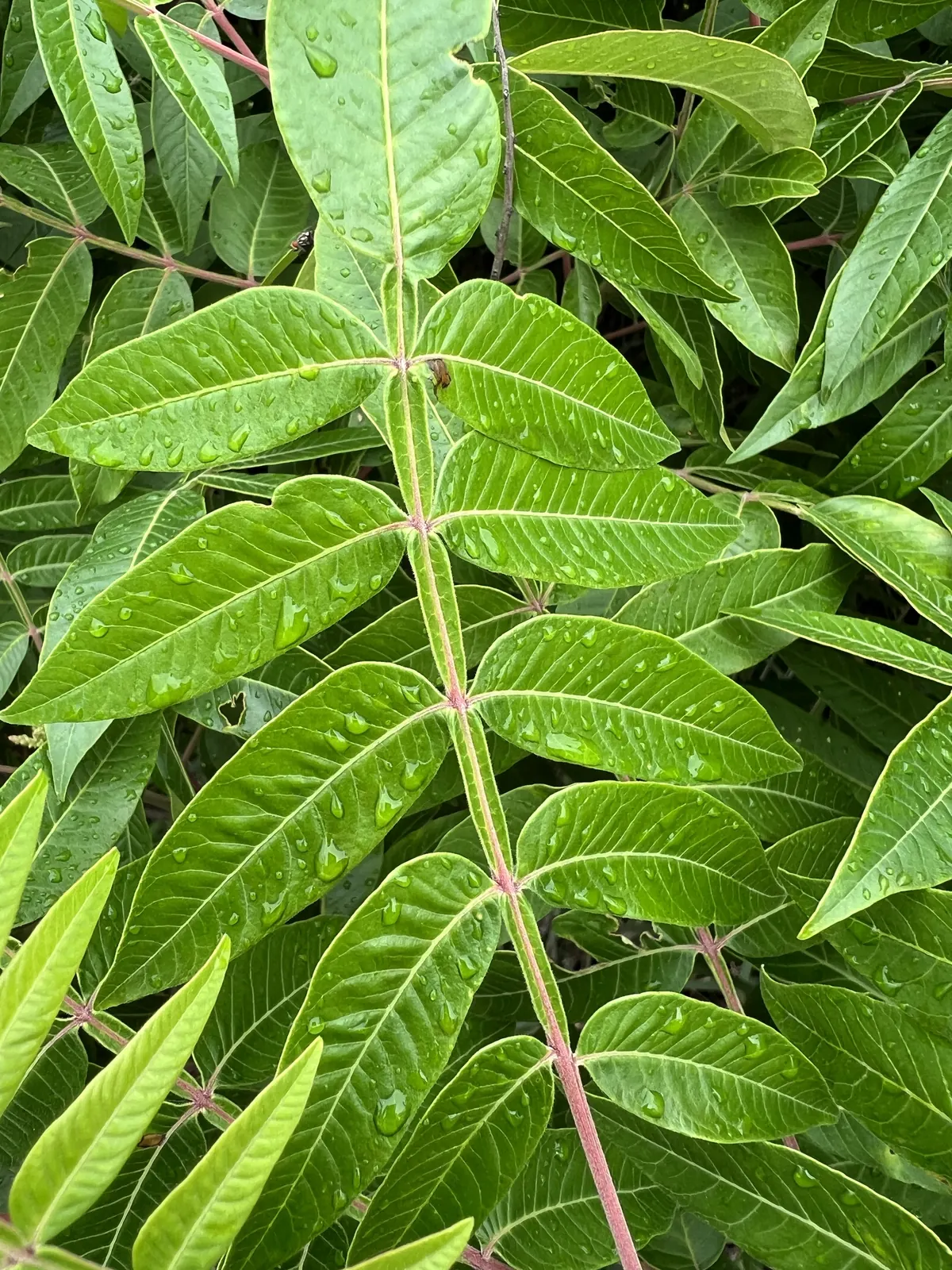
Three features look like they should help but do not settle it on their own. Upright or hanging clusters: staghorn and smooth sumac hold their clusters upright, but winged sumac's ripe clusters often nod or hang, so a drooping cluster does not mean poison sumac. Check the color and where the cluster grows instead. Leaflet edges: winged sumac and poison sumac both have smooth-edged leaflets, so smooth edges do not rule poison sumac in or out. Toothed edges do point you to staghorn or smooth sumac. A red leaf stem: poison sumac's leaf stems are often red, but winged sumac's can be pinkish red too, as you can see in the photo below. Go by the wings, the berries and the ground instead.
The Winged Leaf Stem: The Easiest Tell
Winged sumac gets its name from narrow, flat strips of leaf tissue that run along the central leaf stem between each pair of leaflets.[4] Once you have seen them you cannot miss them, and they are there from the first leaves in spring until the leaves drop in fall, so you can make this check long before any berries ripen.
Poison sumac has a plain, round leaf stem with no wings at all. Neither do staghorn or smooth sumac. So if the stem has wings, you can stop worrying: you are looking at winged sumac.
Its leaflets are glossy, dark green on top and paler underneath, and the whole leaf turns brilliant red to reddish-purple in fall.[5]
What Poison Sumac Looks Like vs Edible Sumac Berries
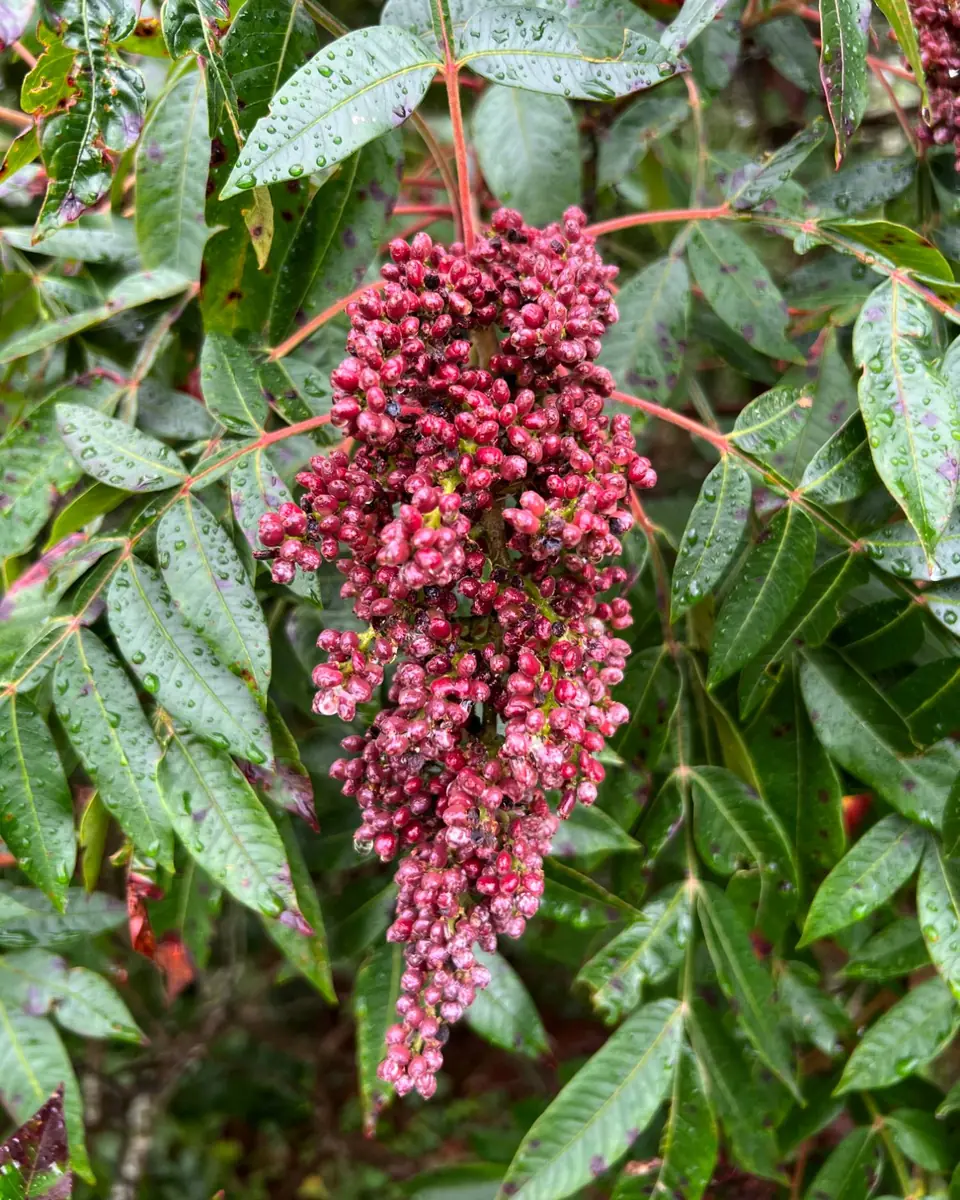
The berries are the second check, and the one most people already half know. The edible sumacs, winged, smooth, staghorn and fragrant, all have red, hairy berries, and winged, smooth and staghorn pack them into dense clusters at the ends of the branches.[3] Run your thumb over a winged sumac cluster and it feels slightly fuzzy, and a lick of your fingertip afterward tastes sour, which is where sumac lemonade comes from.
Poison sumac berries start green and ripen to a dull ivory-white or gray. They are smooth and waxy, and they come in loose, open, hanging clusters up to 10 to 12 inches long that grow from the leaf axils, the spots where each leaf joins the branch, rather than from the branch tip.[1][12] They look a lot like poison ivy berries, which makes sense, since the two are close relatives.[6]
Do not judge by which way the cluster points. Ripe winged sumac clusters often nod or hang, like the one in this photo, and the Missouri Department of Conservation describes them as "erect or drooping."[4] What winged sumac berries never do is turn white. Red, fuzzy and dense at the branch tip means sumac. White, smooth and loose along the stem means walk away.
Where Poison Sumac Grows (and Where Winged Sumac Grows)
Habitat is the check you can make from the truck window. Poison sumac is a wetland plant. New York's Department of Environmental Conservation says it grows only in certain wetlands, specifically fens, calcareous marshes and open wooded swamps, and never in dry upland areas.[6] Across its range it turns up in swamps, bogs, seepage slopes and frequently flooded woods, mostly on the Atlantic and Gulf coastal plains and around the Great Lakes.[7]
Winged sumac wants the opposite. It grows on dry hillsides, prairies, open woods, thickets, glades and rocky slopes, and it is one of the first shrubs to move into old fields, roadsides and fence rows.[5][8] It handles poor soil well but does poorly on wet sites.[2] That is why you see it lighting up road cuts in October.
A note for our neighbors: the Lady Bird Johnson Wildflower Center's state list for poison sumac does not include Arkansas, and the Missouri Department of Conservation says true poison sumac does not occur in Missouri.[7][3] It does grow in nearby states such as Tennessee, Mississippi, Louisiana and Texas, so if you hunt, fish or travel east, the three checks still matter.
Why Poison Sumac Is Not Really a Sumac
Both plants belong to the cashew family, Anacardiaceae, which is why they share a family resemblance in their compound leaves.[7] But poison sumac sits in a different genus, Toxicodendron, alongside poison ivy and poison oak. All of them carry urushiol, the plant oil that causes the itchy, blistering rash.[1]
Botanists once lumped poison sumac in with the true sumacs as Rhus vernix, and the common name stuck after the science moved on.[9] The true sumacs, Rhus, include winged, staghorn, smooth and fragrant sumac, all with red berries. If you want a tour of the whole group, see our guide to types of sumac.
University of Florida extension, in its guide to poison ivy, poison oak, poison sumac and poisonwood, calls winged sumac a "nonallergenic relative" of poison sumac and points to the same tells we use: more leaflets, red berry clusters and a winged leaf stem.[1]
What to Do If You Touch Poison Sumac
Wash soon, gently, and wash everything else too
We are seed growers, not doctors, so treat this as common-sense first aid from public health sources and call a medical professional with any real concern.
- Wash your skin with soap and cool water as soon as you can. The sooner the oil comes off, the better your chances.[10] The American Academy of Dermatology says washing within 10 to 20 minutes can still prevent a rash.[11]
- Wash gently and rinse well. Scrubbing can work the oil into your skin. Rinse with plenty of cool water and clean under your fingernails.[11]
- Wash clothes, tools and the dog. The oil sticks to them and can give you a rash later.[10]
- Never burn it. NC State Extension warns that inhaling smoke from burning poison sumac can be dangerous to the lungs.[9]
See a doctor if the rash spreads to your eyes, mouth or genitals, you run a fever over 100°F, you see pus or soft yellow scabs, the itching keeps you up at night, or it is not getting better after a few weeks. Trouble breathing is an emergency.[10]
Winged Sumac and Poison Sumac: Common Questions
Is winged sumac poisonous?
No. Winged sumac (Rhus copallinum) is not poison sumac and is not in the poison ivy genus. University of Florida extension describes it as a nonallergenic relative of poison sumac. Its red berries are the ones people have long used for a tart, lemony drink. Poison sumac (Toxicodendron vernix) is a different plant in a different genus, with white or gray berries, growing in wet ground.
Can you touch winged sumac?
Yes. Winged sumac is not a poison plant. Broken leaves and twigs bleed a white, sticky sap, so you may want gloves just to keep your hands clean. The Missouri Department of Conservation notes that sumacs can carry trace amounts of the same family of chemicals found in poison ivy in some parts of the plant, so if your skin reacts strongly to poison ivy, skip sumac tea and drinks, and wear gloves when handling the plant as a precaution.
Are red sumac berries safe to eat?
The red, fuzzy berry clusters of winged, smooth and staghorn sumac are the edible ones. People have crushed them to flavor drinking water and to make sumac lemonade and tea. The rule of thumb is simple: sumac you eat has red berries; poison sumac has white or gray berries. If a berry cluster is not red and fuzzy, leave it alone. One caution: the Missouri Department of Conservation notes that a very small number of people who are highly sensitive to poison ivy may have a strong allergic reaction to drinking sumac tea, so if that is you, skip it.
For harvesting and recipes, see our guide to edible sumac and its culinary uses.
Is poison sumac related to poison ivy?
Yes. Poison sumac, poison ivy and poison oak are all in the genus Toxicodendron and all carry urushiol, the plant oil that causes the itchy, blistering rash. Poison sumac was once placed in the sumac genus Rhus, which is how the confusing name stuck.
Can a poison sumac rash spread from person to person?
No. According to the U.S. Food and Drug Administration, poison plant rashes cannot be spread from person to person. You can pick up the oil again from clothing, tools or a pet's fur that touched the plant, so wash those too.
My dog ran through poison sumac. What should I do?
The FDA notes that pets usually are not affected, but the oil can stick to their fur and cause a reaction in someone who pets them. Bathe the dog with pet shampoo while wearing rubber gloves. If your dog seems unwell or has eaten a plant you are unsure of, call your veterinarian.
Do birds eat poison sumac berries?
Yes. The Lady Bird Johnson Wildflower Center notes that the fruit is not toxic to birds and other animals, and that bobwhites, pheasants, grouse and rabbits eat it, especially in winter. Seeing birds on a shrub tells you nothing about whether it is safe for you to touch.
More questions about the plant itself are answered on our main FAQ page.
Winged Sumac: The Friendly Sumac
Once you know the three checks, winged sumac stops being something to fear and starts being one of the most useful native shrubs you can grow. The red berries make a bright, sour drink. The flowers feed bees in summer, and the berry clusters feed songbirds and game birds deep into winter (see wildlife benefits and game habitat). Its suckering roots hold banks and slopes, which is why it shows up on our list of erosion control shrubs.
Best of all, it grows on exactly the kind of dry, tired ground where poison sumac never could. If you want to try it, our planting guide covers everything from scarifying and cold stratifying the seed to spacing.
Grow the Safe Sumac
Wild-harvested winged sumac seeds from our Arkansas stands. Packs from 200 seeds ($14.99) to 3,000 seeds ($94.99), free shipping, for Zones 4 to 9.
Shop Seed PacksSources
12 references- University of Florida IFAS Extension. Identification of Poison Ivy, Poison Oak, Poison Sumac, and Poisonwood (ENH886). Poison sumac form, leaflets, fruit, habitat and urushiol; winged sumac as a nonallergenic relative with a winged rachis. ask.ifas.ufl.edu/publication/EP220
- NC State Extension Gardener Plant Toolbox. Rhus copallinum profile (leaflets, entire margins, winged rachis, hairy red drupes, soil tolerance except wet sites). plants.ces.ncsu.edu/plants/rhus-copallinum
- Missouri Department of Conservation Field Guide. Sumacs (hairy red fruit of the true sumacs, unwinged stalks of smooth and staghorn sumac, poison sumac's drooping white berries and absence from Missouri, trace urushiols in sumacs). mdc.mo.gov/discover-nature/field-guide/sumacs
- Missouri Department of Conservation Field Guide. Winged Sumac (7 to 17 leaflets, winged midrib, fruit clusters "erect or drooping," white sap, habitat). mdc.mo.gov/discover-nature/field-guide/winged-sumac
- Lady Bird Johnson Wildflower Center. Rhus copallinum species profile (glossy leaves, fall color, winged leaf axis, habitat). wildflower.org/plants/result.php?id_plant=RHCO
- New York State Department of Environmental Conservation. Poison Sumac (7 to 13 smooth leaflets, whitish berries, wetland-only habitat, comparison with staghorn and smooth sumac's 11 to 31 toothed leaflets). dec.ny.gov/nature/animals-fish-plants/poison-sumac
- Lady Bird Johnson Wildflower Center. Toxicodendron vernix species profile (habitat, native range and states, urushiol, fruit eaten by wildlife). wildflower.org/plants/result.php?id_plant=TOVE
- USDA Forest Service, Fire Effects Information System (FEIS). Rhus copallinum species review (open woodlands, fields and fence rows; clonal growth form). research.fs.usda.gov/feis/species-reviews/rhucop
- NC State Extension Gardener Plant Toolbox. Toxicodendron vernix profile (red rachis, smooth whitish fruit, former name Rhus vernix, urushiol, danger of smoke). plants.ces.ncsu.edu/plants/toxicodendron-vernix
- U.S. Food and Drug Administration. Outsmarting Poison Ivy and Other Poisonous Plants (washing with soap and cool water, pets, rash not contagious, when to see a doctor). fda.gov/consumers/consumer-updates/outsmarting-poison-ivy-and-other-poisonous-plants
- American Academy of Dermatology. Poison ivy, oak, and sumac: What should I do if I touch a plant? (gentle washing, cool-water rinse, 10 to 20 minute window). aad.org/public/everyday-care/itchy-skin/poison-ivy/touch-plant
- Virginia Tech Dendrology. Poison sumac fact sheet (loose, drooping flower clusters in the leaf axils; white drupes in hanging clusters). dendro.cnre.vt.edu/dendrology/syllabus/factsheet.cfm?ID=581