Native Plants for Birds and Pollinators
Most wildlife plantings come up short in the same quiet way: a burst of flowers in June, then nothing. Bees go hungry in early spring and again in fall, the birds find no fruit after the first hard frost, and the yard empties out. A planting that really works for wildlife is planned around the whole calendar, not one pretty season.
This is how we think about it as a small native seed grower in Arkansas: what birds and pollinators need through the year, a short list of proven native plants sorted by the job each one does, and two starter plans, one for a small yard and one for an acre or more. For what winged sumac itself does for wildlife, see our wildlife benefits page.
What Birds and Pollinators Need Through the Year
Before picking plants, it helps to list the jobs a planting has to do. Birds and pollinating insects need five things, and a good plan covers all of them in every season:
- Flowers from early spring to frost. Nectar and pollen for bees, butterflies, moths, flies, and hummingbirds, with no long gaps.
- Fruit and seed from summer into winter. Summer fruit for nesting birds, fat-rich fall fruit for migrants, and long-lasting fruit and seed for the cold months.
- Host plants for caterpillars. The leaves that feed caterpillars, which in turn feed nearly every baby songbird.
- Cover and nesting structure. Layers of trees, shrubs, grasses, and ground litter where animals can nest, roost, overwinter, and escape predators.
- Water. A shallow, clean source for drinking and bathing.
Plan for Bloom From Early Spring to Frost
The hungriest moments for pollinators are the ends of the season. In early spring, bumble bee queens and solitary bees come out of the ground with almost nothing open. In fall, bees, late butterflies, and migrating monarchs are fueling up when summer flowers are done. A yard that only blooms in June misses both.
Clemson Extension suggests aiming for at least three different species in bloom in each part of the growing season, and planting each species in a mass about three feet wide, so bees can work one kind of flower efficiently instead of hunting for scattered single plants.[1] Trees and shrubs count here too: a single flowering redbud or serviceberry puts out more spring blossoms than a whole bed of perennials.
Plan for Fruit From Summer Into Winter
Bird food works on a calendar too, and not all fruit is equal. Native fall fruits like spicebush and dogwood are rich in fat, which migrating birds burn for fuel, so they tend to be eaten quickly. Lower-fat fruits like winterberry stay on the branch longer and become the food that is left when everything else is gone.[2]
That is the whole trick of fruit succession: plant something that ripens in early summer for nesting birds, something fat-rich for fall migrants, and something that hangs on into winter. Sumac, winterberry, and eastern red cedar fall in that last group.
One practical note: hollies, sumacs, and red cedar carry male and female flowers on separate plants, and only females bear fruit. Plant several, or for named holly cultivars, include a male that blooms at the same time.[3]
Host Plants: Feeding the Caterpillars That Feed Baby Birds
Here is the part most bird plantings miss. Even birds that eat seeds and fruit as adults raise their nestlings mostly on insects, and caterpillars are the main course. The National Wildlife Federation, drawing on Doug Tallamy's research, notes that a pair of Carolina chickadees needs between 6,000 and 9,000 caterpillars to raise a single brood.[4]
Caterpillars are picky. Many can only eat the plants they evolved with, so a yard full of non-native shrubs can look green and still be nearly empty of bird food. A small group of native plants does most of the work. Oaks top the list, supporting more kinds of caterpillars than any other trees across much of the country, and native cherries, willows, and goldenrods also rank near the top.[5] Some well-known pairings:
- Milkweeds are the host plants monarch caterpillars depend on.
- Spicebush hosts the spicebush swallowtail.
- Pawpaw hosts the zebra swallowtail.
- Golden alexanders host the black swallowtail.
- Native violets host fritillary butterflies.[6]
A host plant is doing its job when its leaves have holes in them. A little chewing in June is what a full nest box looks like from the plant's side.
Cover and Nesting Structure for Birds
Food is only useful if animals feel safe getting to it. Think in layers: a canopy tree or two, smaller understory trees, a shrub layer, grasses and flowers, and leaf litter on the ground. Each layer holds different birds and insects, and the more layers you have, the more kinds of wildlife the same piece of ground will carry.
- Group shrubs into clumps or hedgerows rather than spacing them out as single specimens. Dense, twiggy thickets are where catbirds, thrashers, cardinals, and sparrows nest and hide.
- Include some evergreen cover. Eastern red cedar gives birds a place to shelter from wind and cold rain in winter, and juncos, sparrows, and warblers use its dense foliage for roosting.[7]
- Save heavy pruning for late winter, before birds start nesting, and leave a few dead branches and snags standing where they are safe.
- Keep feeders and water close to cover, so small birds have somewhere to dive when a hawk comes through.
Leave the Seed Heads, Stems, and Leaves
The easiest wildlife habitat is the cleanup you skip. Fall tidying removes food and winter shelter right when both are scarcest.
- Seed heads. Coneflowers, black-eyed Susans, asters, goldenrods, and native grasses carry seed that goldfinches, sparrows, and juncos pick at through the winter. Leave them standing.
- Stems. Many small native bees nest in hollow or pithy stems. Oklahoma State Extension suggests cutting spent stems in spring to varying heights between 8 and 24 inches, so the stubble becomes next year's nest sites.[8]
- Bare ground. The Xerces Society estimates that about 70 percent of native bees nest in the ground. Leave some sunny, bare, untilled patches, and skip thick bark mulch in those spots.[9]
- Leaf litter. Rake leaves off the lawn and into your beds instead of bagging them. Bumble bee queens and many moths and butterflies spend the winter in leaf litter and the loose soil beneath it, and ground-feeding birds find insects there in spring.
Skip broad-spectrum insecticides entirely. A planting meant to feed caterpillars and bees cannot also be sprayed to kill them.
Add a Shallow Water Source
Water draws birds that never touch a feeder. Cornell Lab of Ornithology recommends a birdbath no deeper than about an inch at the edges and two inches in the middle, with a stone or branch in the water so small birds can stand and drink.[10] Keep it within a short hop of shrubs, scrub it out and refill it every few days, and add a few flat stones to a pan of water on the ground for bees and butterflies to land on.
Proven Native Plants for Birds and Pollinators, by Role
These are well-documented natives with broad ranges across the central and eastern United States. Ranges and soil needs vary, so check your state's native plant society or extension service before you buy, and favor plants native to your own region.
| Role | When | Good choices | Who it feeds |
|---|---|---|---|
| Early bloom | March to May | Eastern redbud, serviceberry, wild columbine, golden alexanders | Queen bumble bees, solitary bees, early butterflies, hummingbirds |
| Summer bloom | June to August | Wild bergamot, purple coneflower, butterfly milkweed, mountain mint, winged sumac | Bumble bees, native bees, wasps, butterflies |
| Fall bloom | August to frost | Goldenrods, New England aster, aromatic aster | Late bees, migrating monarchs, other butterflies |
| Summer fruit | June to August | Serviceberry, blackberries and black raspberries, American elderberry | Nesting songbirds and their fledglings |
| Fall and winter fruit | September to March | Flowering dogwood, spicebush, American beautyberry, winterberry, winged sumac, eastern red cedar | Migrants in fall, resident birds in winter |
| Caterpillar hosts | Spring and summer | Oaks, black cherry, milkweeds, spicebush, pawpaw, violets | Caterpillars, and the nestlings that eat them |
| Evergreen cover | All year | Eastern red cedar, American holly | Roosting and sheltering birds in winter |
Early bloom
- Eastern redbud (Cercis canadensis) flowers before it leafs out and is an important early food for bumble bees and carpenter bees, and leafcutter bees use its leaves to build nests.[11]
- Serviceberry (Amelanchier species) is among the first woody plants to flower, feeding insects when little else is open, and it fruits again in June.[12]
- Wild columbine (Aquilegia canadensis) offers nodding red and yellow flowers that suit returning hummingbirds and long-tongued bees.
- Golden alexanders (Zizia aurea) bloom in spring for small bees and flies and double as a black swallowtail host.
Summer bloom
- Wild bergamot (Monarda fistulosa) is a bumble bee magnet for weeks in midsummer.
- Purple coneflower (Echinacea purpurea) feeds bees and butterflies in summer and goldfinches later, if you leave the seed heads.
- Butterfly milkweed (Asclepias tuberosa) is a nectar plant and a monarch host in one, and it handles dry, sunny ground.
- Mountain mint (Pycnanthemum species) is plain to look at and usually covered in small bees and wasps.
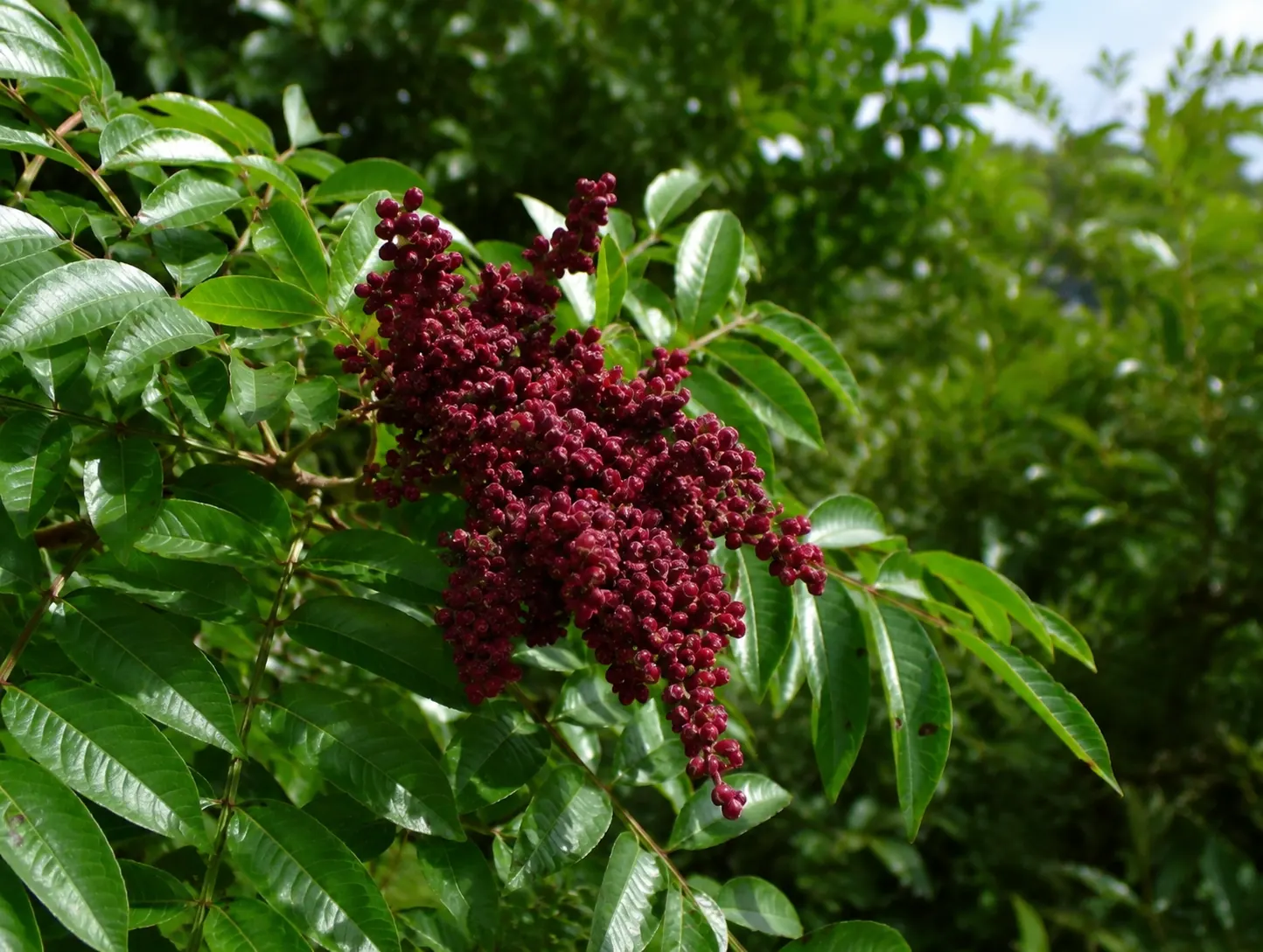
- Winged sumac (Rhus copallinum) blooms in the middle to late summer stretch, with dense flower clusters that bees and butterflies visit for nectar.[16]
Fall bloom
- Goldenrods (Solidago species) are a key late food for bees and butterflies, and they do not cause hay fever. That is ragweed, which blooms at the same time and spreads its pollen on the wind.[13] Some goldenrods spread hard, so choose clump-forming kinds for small beds.
- New England aster (Symphyotrichum novae-angliae) and aromatic aster (S. oblongifolium) carry purple flowers into fall, often until frost.
Summer fruit
- Serviceberry berries ripen in June, which is why it is also called Juneberry.[12]
- Blackberries and black raspberries (Rubus species) give fruit and thorny nesting cover in the same tangle.
- American elderberry (Sambucus canadensis) carries big flat flower clusters in early summer and heavy clusters of dark fruit in late summer.
Fall and winter fruit
- Flowering dogwood (Cornus florida) and spicebush (Lindera benzoin) bear fat-rich fruit that fall migrants strip quickly.[2]
- American beautyberry (Callicarpa americana) is a southern shrub with clusters of purple fruit in fall that birds keep eating into winter.[14]
- Winterberry (Ilex verticillata) likes moist soil, and its red fruit persists through winter on bare branches.[3]
- Winged sumac fruit clusters hold on the plant into winter.
- Eastern red cedar (Juniperus virginiana) females carry blue berry-like cones that cedar waxwings and many other birds eat through fall and winter.[7]
Host plants for caterpillars
- Oaks (Quercus species) are the single best tree you can plant for caterpillars, and they are worth planting even though you will not see them at full size for years.[5]
- Black cherry (Prunus serotina) feeds a long list of caterpillars and gives birds summer fruit.
- Milkweeds, spicebush, pawpaw, and violets each host particular butterflies, listed above.
Evergreen cover
- Eastern red cedar grows almost anywhere in the central and eastern states and makes dense winter shelter.
- American holly (Ilex opaca) gives food and evergreen cover for birds where it is native, mostly the eastern and southern states.[15]
Where Winged Sumac Fits in the Plan
We grow and sell winged sumac, so we are biased, but it earns a spot in this plan by doing two jobs at once. Its flowers open in the middle to late summer window, roughly July into September depending on where you are, which bridges the gap between the June flush and the goldenrods.[16] Then its fruit clusters ripen in fall and persist into winter, so it lands in the late fruit group with winterberry and red cedar.
It also builds structure. Winged sumac spreads by root suckers into a thicket, which is exactly the dense shrub cover birds want, and it does it on dry, poor, sunny ground where most fruiting shrubs struggle. The same habit means it belongs on a fence line, a slope, a field edge, or a back corner, not in the middle of a tidy bed. Because it carries male and female flowers on separate plants, plant a group from seed rather than a single shrub so you end up with fruiting females.
For the full detail on its bird list, pollinators, and host-plant role, see wildlife benefits of winged sumac. To grow it, start with our planting guide and the steps to scarify and cold stratify the seeds.
A Starter Plan for a Small Yard
You do not need much ground. A typical suburban lot can cover every role with about a dozen kinds of plants:
- One small tree: a serviceberry or eastern redbud for early bloom, plus June fruit from the serviceberry.
- A shrub group of three to five: mix one fall-fruit shrub (spicebush, beautyberry, or winterberry, depending on soil and region) with one summer-fruit shrub such as elderberry.
- A sumac corner: a small patch of winged sumac along a back fence where you can mow around the suckers.
- A flower bed in masses: three species per season, each in a three-foot clump. For example columbine and golden alexanders, bergamot and mountain mint and butterfly milkweed, then goldenrod and New England aster.
- The soft layer: leaves left under the shrubs, a bare sunny patch for ground bees, and a shallow birdbath near cover.
Convert the lawn one bed at a time.
Planting for an Acre or More
With more room you can plant in bigger, simpler blocks and let natural processes help:
- Hedgerows on fence lines and field edges, mixing sumac, elderberry, dogwood, blackberries, and red cedar. Edges are where wildlife concentrates.
- A thicket or two of winged sumac on a slope or a corner that is hard to mow. See our notes on shrubs for erosion control and game habitat.
- A wildflower and native grass meadow, seeded with goldenrods, asters, bergamot, coneflowers, little bluestem, and switchgrass, mowed once in late winter so the seed and cover stand all winter.
- Room for oaks and black cherry, planted now for the caterpillars your grandkids' birds will eat.
- Brush piles and snags left in out-of-the-way spots for wrens, sparrows, and rabbits.
For larger plantings, our 1,500 and 3,000 seed packs are sized for hedgerows and habitat strips.
Common Questions About Planting for Birds and Pollinators
What are the best native plants for pollinators?
There is no single best plant. The best planting is a mix that keeps something in bloom from early spring to frost, ideally at least three species in each season. Proven choices across the central and eastern US include eastern redbud and serviceberry in spring; wild bergamot, mountain mint, purple coneflower, butterfly milkweed, and winged sumac in summer; and goldenrods and New England aster in fall.
What shrubs are best for birds?
Choose shrubs that fruit at different times and grow dense enough for cover. Serviceberry and elderberry fruit in summer, flowering dogwood and spicebush in fall, and winterberry, winged sumac, and eastern red cedar hold fruit into winter. Plant them in groups or hedgerows rather than as single specimens.
Is winged sumac good for birds and pollinators?
Yes. Winged sumac blooms in the middle to late summer window, when bees and butterflies come to its flower clusters for nectar, and its fruit clusters ripen in fall and persist into winter as late bird food. Its suckering thickets also give birds dense cover.
Add Winged Sumac to Your Wildlife Planting
Hand-harvested seed from wild Arkansas stands, from a 200-seed starter pack to 3,000 seeds for hedgerows and habitat strips. Free shipping on every pack.
Shop Seed PacksSources
16 references- Clemson Cooperative Extension, Home & Garden Information Center. Plan Now for Pollinators (three species blooming per season; three-foot masses). hgic.clemson.edu/plan-now-for-pollinators
- UNC Charlotte Botanical Gardens. Fall Berries for Migrating Birds (fat content of native fall fruits; high-fat fruits eaten first, winterberry persists). ui.charlotte.edu/story/fall-berries-migrating-birds
- University of Maryland Extension. Winterberry Holly (male and female plants; only females fruit; fruit into winter). extension.umd.edu/resource/winterberry-holly
- National Wildlife Federation, Native Plant Finder. About (Carolina chickadees need 6,000 to 9,000 caterpillars to raise one brood). nativeplantfinder.nwf.org/About
- National Wildlife Federation, National Wildlife magazine. Power Plants: keystone plants and the caterpillars they support. nwf.org/Magazines/National-Wildlife/2022/April-May/Conservation/Keystone-Plants
- Penn State Extension, Center for Pollinator Research. Butterfly Host Plants (larval hosts including milkweed, spicebush, pawpaw, golden alexanders, violets). pollinators.psu.edu/assets/uploads/documents/Butterfly-Host-Plants-022518.pdf
- Connecticut Audubon Society. Eastern Red Cedar (fruit eaten by cedar waxwings and other birds; dense foliage used for roosting cover). ctaudubon.org/news/january-2023-eastern-red-cedar
- Oklahoma State University Extension. Leaving Plant Stems for Native Bees (cut stems to varying heights of 8 to 24 inches). extension.okstate.edu/announcements/horticulture-tips
- The Xerces Society for Invertebrate Conservation. Nesting and Overwintering Habitat (ground-nesting bees, stems, and leaf litter). xerces.org/pollinator-conservation/nesting
- Cornell Lab of Ornithology, All About Birds. Attract Birds With Birdbaths (one inch deep at the edges, two inches at most in the middle). allaboutbirds.org/attract-birds-with-birdbaths
- University of Illinois Extension. Redbuds Are a Great Addition to Any Landscape (early food for bumble bees and carpenter bees; leafcutter bees). extension.illinois.edu/blogs/good-growing
- University of Wisconsin Extension, Horticulture. Serviceberry, Amelanchier (early bloom; June fruit eaten by birds). hort.extension.wisc.edu/articles/serviceberry-amelanchier
- Penn State Extension. Native Perennials for Fall (goldenrod pollen is not airborne; asters bloom into fall). extension.psu.edu/native-perennials-for-fall
- University of Tennessee Extension, Tennessee Smart Yards. Callicarpa americana (berries eaten by birds into late fall and winter). tnyards.utk.edu/callicarpa-americana
- Rutgers Cooperative Extension. Winter Trees, Part 2 (American holly as a native tree giving food and cover for birds). hunterdon.njaes.rutgers.edu/wp-content/uploads/2022/05/Winter-trees-part-2.pdf
- NC State Extension Gardener Plant Toolbox. Rhus copallinum (summer bloom July to September; bees and butterflies nectar at the flowers; fruit persists into winter; separate male and female plants). plants.ces.ncsu.edu/plants/rhus-copallinum